Link to published article: The Hidden Gift
There is a small island in French Polynesia that reminds me of that last gift left abandoned under the Christmas tree, passed over for all the other larger bow-tied, red-and-green wrapped packages. When the party is over and all the extended family have made their way home, a tired eye spots a small paper bag bound in scotch tape left half buried beneath the fallen pine needles and discarded wrapping paper. It is picked up, casually unwrapped and the holiday’s greatest surprise lays unexpectedly in hand.
Maupiha’a is this modest little treasure. After spending time in French Polynesia’s larger, more well-known islands, few have time remaining on their visa or in the season to tuck into Maupiha’a on their way west. With a total landmass of 2km2, sailing right past is certainly an easy thing to do. For those who choose to visit, they may need to abort due to the small island’s even smaller pass. With a circular lagoon surrounded by one main islet, several smaller motus and a continuous outer reef, all the water that floods into the lagoon at high tide must exit through the single passage on the western side of the atoll. This fast out-flowing water can cause currents up to 9 knots, so timing entry is essential. The best time to enter is at high water with the engine at full speed. The current will still be against you at about 4 knots but you can at least make slow progress. Once committed, there is no turning around inside the narrow 18 meter-wide pass. Those who succeed, however, soon discover what a hidden gift Maupiha’a really is. Unassuming on the outside, a rare treasure on the inside: Maupiha’a is that lost gift hidden under the Christmas tree.
Located on the western edge of the French Polynesian archipelago, Maupiha’a is the epitome of isolation, its residents a model of self-sufficiency. It is 100 miles from its nearest populated neighbour and there is no supply ship that comes to deliver food and staples as exists in other French Polynesian islands. The locals on Maupiha’a raise pigs and chicken, collect tern and booby eggs and hunt for fish, shellfish and turtle. They maintain their own small gardens and drinking water is collected by catchment or cracked from a coconut. What isn’t grown, raised or hunted is brought in by a seasonal convoy of willing international cruisers who come laden with flour, rice, sugar, seasonal fruit and a myriad of other staples during the dry season. When the flow of cruisers ends, life returns to a self-sustaining isolation until the Pacific fleet resumes the following year.
I sailed into Maupiha’a in 2006 carrying fresh fruit and vegetables donated by family in distant islands, however this time we were behind a group that had already done the same. Back then the lagoon had been a minefield of oyster beds, but a hurricane wiped out the buoys and killed the industry since my last visit. While Maupiha’a had a short period in pearl farming, it has primarily been used over the past century as a copra plantation. Starting with a workforce of three in 1917, the influx of workers shifted from several hundred at the height of the industry to the handful that now remain. For a scheduled ship to make the trip to the island, the residents must collect a minimum of 50 tons of copra — an amount that takes the current eight inhabitants about two years to harvest. It is a long time to wait for a replenishment of supplies, so visiting yachts are both a welcome and necessary part of survival on the island.
As such, cruising boats are met with open arms when they enter this small mid-Pacific sanctuary. We sailed across the four-mile wide lagoon to the southern side of Motu Maupiha’a and dropped our anchor through crystal clear water into fine white sand, as picturesque as any holiday postcard. We wandered ashore to take a stroll on the palm-fringed beach and soon ran into one of the island’s locals. Pierre was warm and gregarious, inviting us to make ourselves at home on his island. I offered a pair of flip-flops to replace his broken one, but he insisted on scavenging a lone replacement from the windward side of the outer reef where the supply was plentiful. We passed him again the next day, and he waved us over and offered us fresh fish for our meal that night. I accepted on the agreement that he join us, and that first meal set the foundation for communal living for the rest of our time together. Pierre showed us how to live off the island’s resources, turning us into prime contestants for Survivor Island. He taught us how to hunt, kill and clean meat off a coconut crab, how to determine if a tern egg was embryo-free, how to pluck a coconut from a tree and make fresh milk, how to catch a fish on a un-baited lure (in 5 seconds, guaranteed). By the time he was finished with us, we could be cast ashore on any mid-Pacific island and feed like royalty if given a rubber band and a rusty hook. In exchange, we supplied Pierre with a regular dose of coffee, his drink of choice, and took him on his first sailing trip since his arrival seven years earlier. We also left him with a six month supply of mayonnaise, the “magic sauce” to accompany smoked coconut crab. Pierre was happy to live in the present and take each day as it comes — and that lesson was the greatest gift of all.
After a week of exploring Maupiha’a natural resources with Pierre, we departed with the change in wind to find a more settled holding on the northern side of the atoll. We reluctantly said our farewells, feeling we’d never find such unbridled generosity and hospitality anywhere else, only to find it replicated by our hosts in our new location. As soon as we landed our dinghy ashore, a mother-and-daughter pair came out to greet us. They had been in the middle of burning coconut husks in a fire, and they took a break from this sweaty work to extended a warm welcome and escorted us around the area, showing us their small garden, a motley collection of animals, and their home. We were offered that day’s catch and I accepted on the grounds that we share the fresh-caught spoils. I came ashore that evening expecting to be given a fish that I would cook over an open fire, and packed a number of side dishes, plates, and a bottle of wine to accompany the meal. When we arrived, the table was set and a full five course meal was already prepared, a green coconut waiting on a plate for each of us. I offered the wine but it was rejected as a slightly fermented coconut was the “champagne” of choice. I humbly accepted the one-sided extravagance that was offered us, knowing that they put aside that day’s work to provide us with such a lavish meal: We had fresh grilled fish, tuna sashimi, coconut crab “pate,” stewed giant clam, and a freshly baked chocolate cake. The night was chatty and festive, and evenings of shared meals remained throughout the duration of our stay.
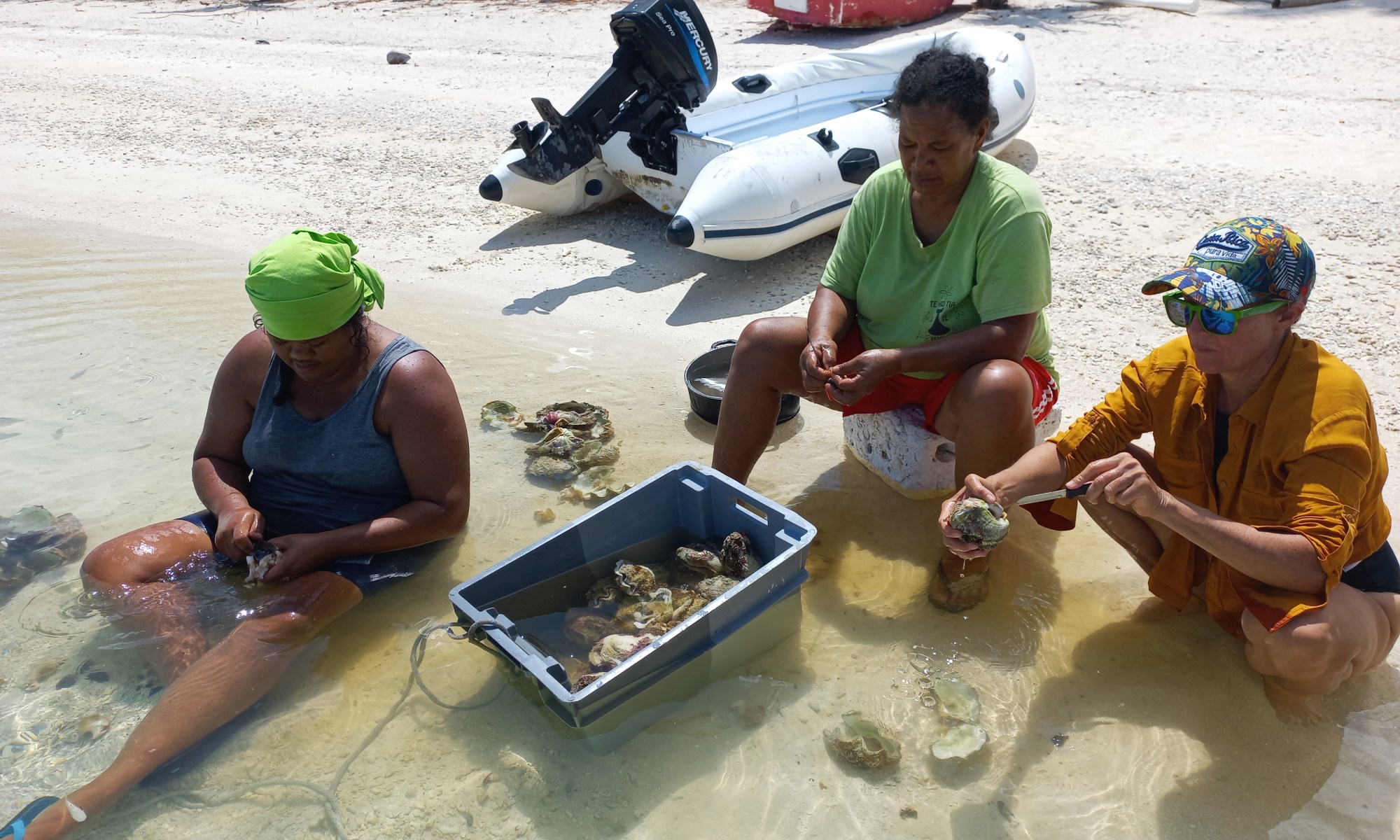
As with Pierre, Adrienne and Karina invited us to join them in their daily routines and taught us about life on the island, and how to survive on it. We were taken out out to one of the smaller islets to walk among booby hatchlings, their downy heads straining to get a look and size us up as a threat. We were shown how to hunt for coconut crab in the night, Karina’s strong, deft hands a stark contrast to my timid, blundering fingers. I would willingly survive on bird eggs, but only desperation would force me to tackle one of those Hulk-sized pinching terrors. Having witnessed the mass graveyards of giant clams throughout the Caribbean, we went on a snorkelling exhibition to learn how to pry the shell from the rock. I massacred one of these vibrant purple beauties with a flathead screwdriver but had no interest in removing any more of these vibrant creatures from the ocean. Forty clams were harvested for a single meal, served as a delicacy that night and it was, indeed, a tasty one. However, I felt guilty eating something that I know to be endangered. I was only playing “stranded” on the island for a short period of time, and with an estimated eighty boats passing through in a season there would be an incredible demand put on the clam population. Hopefully a balance is reached during the off-period to let the population recover in time for the next season’s fleet.
Karina also took us out to snorkel the pass, a popular gathering spot for grey, white and blacktip shark. The site was my only instance of aggression by shark on my earlier visit and I was nervous to get back into the water with an even larger group patrolling the seafloor. They were curious but not aggressive, so we enjoyed being swept along with their darting silver forms following underneath us through the pass. Laying in five meters of water outside the pass was the highlight of the tour: Seeing the scattered remains of the Seeadler, a WWI German sailing warship that had grounded on the outer pass 100 years ago, taking the island’s population of three and turning it into an instant settlement of 111. The mixed group of crew and prisoners of war were stranded on the island for several months, building the “Seeadlerburg Settlement” out of the broken wreckage of the ship. The history of the ship and the story of its crew is as rich following the wreck as before it grounded, and to see its rusty bones scattered across the scarred earth was a poignant moment for us all.
Little did we expect our days and nights to be so richly filled with new-found companionship when we drove our yacht through the daunting pass into this little mid-Pacific refuge. If there ever was a place that time forgot, it is Maupiha’a, where living off the land — and sea, for that matter — is true to the word. While the modern world has settled into much of French Polynesia, Maupiha’a remains a little slice of ancient Polynesian past. There is no bi-monthly supply ship, no church or school, no medical facility or governmental office. There isn’t an airport, cruise terminal or tourist centre. Definitely forget your Marriott or Four Seasons. Whoever visits, whether permanent or transient, must come fully self-sufficient. According to Pierre, this is part of the attraction: Life is simple, needs are basic and demands are minimal.
As an outsider, our hosts showed us that Maupiha’a is, above all, the epitome of selfless generosity. With copra to process, small livestock to raise, a garden and home to maintain and fish to hunt, life is not idle on this little island. But regardless of everything it takes to maintain an existence on the island, routines shifts when visitors come a’calling. Daily chores become tourist expeditions, meals become banquets, strangers become friends. We could not have guessed from the outside the treasures that lie within. Maupiha’a is that forgotten gift, which once unwrapped holds a value far greater than all the other presents put together. It is proof that, sometimes, the best things do come in the smallest packages.


Kia Mia, read your article, and
LikeLike
Hey beautiful- I can’t wait unt
LikeLike