A Movie Medley: The Adventures of Tin Tin and his Motley Crew

Movies are common popular references and here I’ll use a few to illustrate our past three weeks in the Western Province, Solomon Islands. Tin Tin, Crocodile Dundee, Tomb Raider and Raiders of the Lost Ark – recent events for us could have easily been scenes cut from action films on which so many of our childhood fantasies are based. We’ve accumulated many exceptional moments in our recent travels that leave us buzzing as we sail south from our last Solomon island into new territory where new thrills, no doubt, await. It is hard to imagine a continued stream of such highs, however, and we depart from a whirlwind of spectacular cinematic moments – we’ll share just a few.

From Into the Red we headed ‘Into the Unknown,’ choosing to leave the fleet in Vomovomo Lagoon where the promised “Jewel of the Solomons” fell flat into a murky lagoon and bland cruising grounds. Because of intense logging, many of the idyllic lagoons that once offered crystal clear waters, stunning reef and abundant fish life are now brown with muddy overflow and scarred hillsides. Crocodiles which once inhabited inland lakes have lost their natural habitat; where islets and lagoons were previously free from their threat, croc’s have now become permanent residents in the saltwater shallows.

We found little to keep us in this once reputed wonderland, and decided to hunt for jewels in less traveled grounds. Choiseul was an island group north of New Georgia where we decided to spend the remainder of our time before being due back in Gizo for clearance. We left the most of the rally yachts loitering around this tepid scene and set off for an adventure. And that – day by day – is exactly what we found.

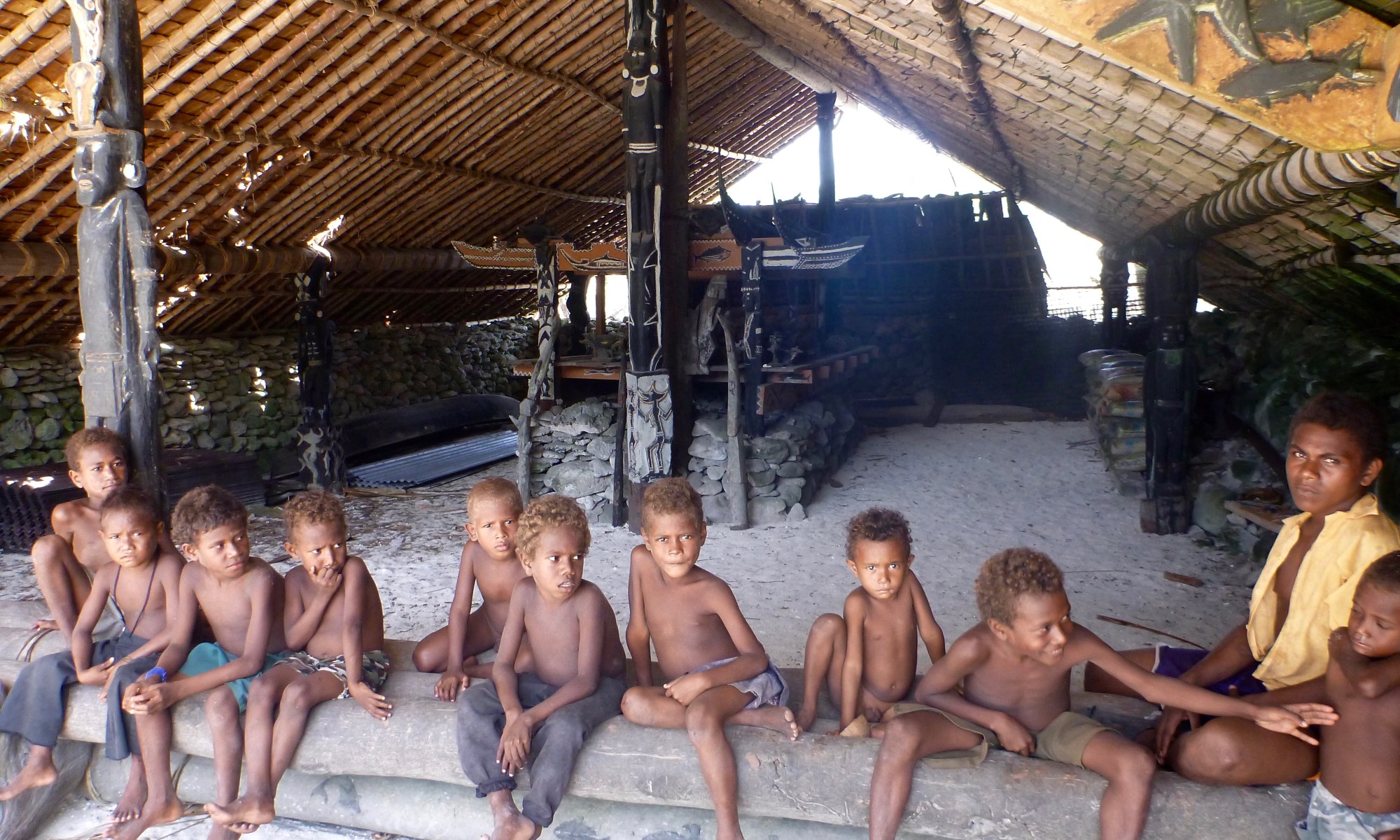
After provisioning in Noro, a dirty port town with little on offer but a ragged seaside market and a few street side shops, we made it to Paradise Bay on the north of New Georgia. We anchored deep within the bay and spent the event chattering with the villagers as they came out in segregated rushes. Starting with tight-lipped stern-eyed men who challenged our comfort factor and had us questioning our safety, we were next visited by a convoy of women in dugout canoes offering fruit and vegetables and the curious eye. Braca put on a charming performance and his warm reception eased our earlier trepidation. We were inundated in our third wave of visitors by children on a dozen miniature canoes, all clamoring to touch B’s little white toes and wiggly fingers. Engaging with them with the silliness reserved for children, we soon had them screeching and laughing along with us as we bantered gibberish back and forth. All fun and games until an elder in a dugout canoe threw out one curt word in passing and they all scattered like flies, leaving us to enjoy the silence only brought in deep bush and calm waters. The birds were varied and prolific, and we listened to their calls as we settled in for the night.

In Tin Tin’s next adventure, his little ship sped north through squally weather to an isolated island off Choiseul’s southern coast. We stern tied to a tiny crescent beach and planned to spend our next days snorkeling the sharply shelving reef on either side of the cove. Through the clear water we could see monster fan corals, the promise of underwater riches to explore. However, the weather was to deal us another hand, and soon after we settled in a northerly squall struck upon us and turned our protected cove into a lee shore. Because of the tight anchorage and the reef hugging our port and starboard side, we felt it unsafe to stay and struggled to pull up anchor in the pelting rain. We tried lifting from all angles but the anchor wouldn’t budge as the winds pushed our boat sideways, straining our holding lines. Stuck fast, we had to hold tight for the night hoping that conditions wouldn’t worsen and bring us in contact with the coral just yards off our sides. Fortunately the weather settled and in the morning John dove to check out the situation where he found the anchor wedged deep under a boulder 100 feet deep. We decided to scoot for a new anchorage after he dug it loose and freed us from our trap, leaving the beckoning fans as we waved our farewell.

Picture Indiana Jones and his cohorts clinging on with tight grip as they are dashed down swift rapids amongst deep jungle bush. Forward to another leg in our journey, as we take Atea north through a narrow channel that cuts through the eastern end of Choiseul. This is the Ngosele Passage, a liquid trail that starts in the south with large open bays lined with tiny village settlements, quaint houses built on stilts over the waters edge, and winds into a narrow slip as the banks steepen towards the deserted north coast. As the passage narrows it becomes more akin to a thin winding river fifty yards across with steep valley walls that rise sharply on either side. Atea passes through thickly forested river banks as the current sweeps us north, past rocks and whirlpools, shoals with overhanging vines and tree trunks that lean out across the water to arrest our passage. As our little Tin Tin holds onto the rail, giggling at the various noises of the jungle, one can imagine Indiana Jones laconically waving his hat at the astonished locals who gape at an ocean going yacht penetrating this deep inland. “No other yachts have been here all year!” they say, and Indiana responds, “We are on our way to find treasure.”

We as we pop through the passage into the open water at the north entrance, we expected to find a well-reputed fishing lodge, generously called a “resort” though any such accommodation in these parts would question the liberal use of the term. We’d discussed timing our travels to hit the lodge for our two-year anniversary so that we could splash out for a meal ashore to honour the special occasion, however we declined to rush through for this indulgence. A good call that’d been, as it turns out there isn’t as much as a viable hut standing in the indicated location. The aggressive vines had reclaimed their turf and swallowed up a dilapidated shack and rusted shed that’d once been boldly claimed a tourist haven. We laughed at our non-existent luxury resort and carried on to find our veiled treasure.

Cut to Treasure Island: A remote cove with very shallow water, secure and protected from the sea. Even our film heroes would have put their adventures on hold to relax on these shores, a magical spot in the remote recesses of the world. The waters were clear, the beach deserted and the weather idyllic. The birdlife was abundant and their calls melodic as they chirped and chattered above us, but other than their company we enjoyed solitude and the serenity around us.

We had one isolated incident when our reverie was disturbed by a passing canoe, three locals paddling past us on their way to fishing grounds. I’m sure Atea was as surprising a sight to them as they were to us. They slowly paddled over and pulled alongside Atea. I usually greet visiting locals with warm welcome, but these three were a tough crowd as they approached us with stern faces. Their leader was the spitting image of a scowling Mr. T, and we had no “social barometer” to gauge whether ‘The A Team’ was friendly or not. It was a moment when you realize how exposed you are in a cruising yacht, a beacon of affluence and a coffer of prize goods. As Mr. T and his two cohorts held onto our lifelines and scanned the boat, none offered comment or smile while John and I tried to stir up pleasant conversation. They lingered in silent observation and our discomfort grew, knowing that we were powerless in an altercation in our remote and isolated anchorage. One flick of his powerful wrist, and Mr. T would crush our bones in a mighty grip. I bounced my child above my head, forcing Braca into fits of giggles to placate any familial sensibilities in the men. They finally left us, as silently as they’d come, and we breathed an audible sigh of relief at our departing guests.

Skipping ahead and returning to the big screen, our movie medley continues with Mick Dundee stepping in to play the lead role. We took Atea to an outlying island, looking for another prime dive spot. The island we landed, Ondolou, looked to provide just that. Another uninhabited anchorage with white sands crowned by reef at each end of the beach. Stern tied in the middle of the bay, we settled Braca in for his afternoon nap and rushed off to explore the underwater amusement park. The life under our hull was prolific, and soon we were diving and dancing with a swirling mass of reef fish, clumped together into a bait ball of silvery scales and fins. I pulled alongside John who was calmly pointing at something just to the left of us. John hadn’t registered the background and had directed me to a little black fish that swam in the foreground. I froze as my eyes registered on a dark green form ten feet away; clearly we’d not been the only ones enjoying the fish life. Resting on the seabed was an eight-foot crocodile, who turned his head at us in interest. We froze, and he began a slow ascent in front of us. As our brains registered the threat, we slowly began to back-paddle as he came to the surface and eyed up his unwelcome guests. To make it to the safety, we retreated to the beach, walked along to where Atea’s stern was tucked into the beach and swam like hell to her boarding ladder. Once safely on her deck with our butts still intact, our adrenalin kicked in and we were buzzing with the excitement of the amazing encounter. We spent the remainder of the afternoon with a chilled glass of wine in one hand and binoculars in the other. We’d clearly intruded on the crocodile’s territory. He returned to his perch on the reef after a slow meander out around the bay, presumably satisfied that his claim to the reef was not going to be challenged. He kept rising to the surface every 15 minutes or so to fix us with a beady eye and confirm that we had not changed the script. As Mick Dundee’s stunt doubles, I think we did justice in confronting the colossal croc. We can’t claim that we tucked him under armpit and had him flopping in the shallows in pain and panic, but we did look him in the eye, kept our cool and – like the professionals that we are – got the fu&% out of there!!

And that ended our underwater exploration in what was intended to be near-total submersion in our island oasis. We’d thought that we would be swimming and snorkeling morning, noon and night, but our resident crocodile won the turf war. We made quick dashes to shore and kept our toes well clear of deep water and an eye to the waters surface for any predators of the sea. It was far from the relaxing afternoons we’d anticipated; however, we did get a once-in-a-lifetime encounter and were lucky to escape unscathed.

We’d early set sights on a small nature reserve in the northwest corner of the Solomon Islands, a small island group located in the Manning Straight between Choiseul and Isobel. We’d dropped the idea early on as it was too far away. From Choiseul, it was to the east and not the direction you want to be heading in trade winds (which flow east to west), but a lucky break in the weather allowed us to scribble it back onto our itinerary. The easterly winds that would have normally made it difficult for a yacht to reach dropped off for a day and we jumped at the small window of opportunity.

Here, we hand over the narration from Hollywood action film to the more sober BBC wildlife teams or “The National Geographic Channel” – for what we found in Arnarvon Islands was straight out of a TV wildlife documentary.  The rangers were thrilled to get visitors and immediately took us snorkeling and, as you’d expect, the fish life was prolific and the corals were piled high on the sea floor. We nearly fell on a white tip reef shark as we made our entrance and were soon enveloped in a shoal of reef fish, darkening out the light above our heads. One of the rangers did baby duty in the boat as another snorkeled alongside us, stepping on live coral to clear his goggles… not the most conscientious in regard to protecting the reef! Afterward we were taken to one of the outer islets to hunt megapode eggs, stopping for a little “turtle rodeo” along the way… again, not the most conscientious as the little tin boat roared after sea turtle caught in our line of sight. I was intent on finding these rare eggs as it was a fellow cruisers focused purpose to find these golden beauties for a mega-megapode omelet. As her 40th birthday was around the corner, I wanted to present her with these as a gift. We succeeded, and as fertilized eggs they were near hatchlings. Dramatically, she cracked her three eggs into a mixer and three feathered bundles spilled out into the bowl. Not quite the surprise I’d intended.

Our biggest thrill in Arnarvon came after dark. At eight o’clock we met the rangers ashore and went patrolling the shoreline on the opposite coast for Hawksbill turtle’s nests, looking for those ripe to hatch. One was declared ready. We dug down with our bare hands and soon found the sand alive with baby turtles, wriggling and finning upwards towards the light and the sound of the surf. A hundred of the cutest little critters scrambled out over our hands and feet as we guided them to the sea. Tin Tin shrieked with excitement as the first of the brave little guys reached the sea, as Squirt and 92 of his brave brothers wriggled out into the surf and towards the EAC. What a moment it was! Perhaps not full of movie drama, but certainly nature at its finest. 

As playtime in the Solomons was nearing a close, we were running short of time and there were a number of attractions that we wanted to see in the greater Gizo area. In addition, we were due for clearance soon and needed to reconnect with the rest of the rally. It was hard for us to turn our ship southbound and leave these treasured isles, but we finally set sail one late afternoon to rejoin the group.

Immediately after an overnight passage that brought us into Gizo’s outskirts, John and I hit a wreck dive onto a 300-foot sunken Japanese freighter, the Toio Maru, sitting off the beach in 30 meters of water. She was spectacular, with great gouges in her bowels spilling small tanks and sake bottles; we ducked into her dark holds to explore her gifts. Our holding in the bay was not a secure one, so after the dive we pulled up anchor and sailed around the corner to reconnect with our friends on Al Fresco.

The following morning we went for a snorkel in some outer islets and ran into a mass of dolphin on the way. It was beautiful; we were in the most stunning setting watching 50 or so dolphins cavort in the waters around us, pods in every direction. I kept jumping in the water but couldn’t get close enough for an underwater encounter. They seemed to be in hunting mode. As a bait ball glittered in the sunlight, the dolphins would dive deep under the dingy and blow rings of bubbles that would pop the surface around us.

Nearby lay Kennedy Island, so named after a young naval lieutenant (who later became President of the United States) who was shipwrecked during WWII and washed ashore on its beaches. While JFK made the islet famous, the tiny slip of land is now renowned as a superb dive site. We’d planned to dive its outer wall while Braca’s adoptive cruising granny, G.G., watched him. We botched our outing by forgetting weights and dive computer so with a grumble we lopped off the dingy with mask and snorkel; we soon forgot our disappointment. White and black tip reef shark patrolled the wall, surveying the overpopulation of reef fish with a stern eye. The islet upheld its reputation.

Our Solomon escapades had come to a close. The majority of the rally was tucked up in Gizo town getting their supplies replenished and their yachts ready for the passage to PNG and it was time for us to rejoin them. We pulled into Gizo harbor early on a Friday morning, the last of the yachts to arrive. I left John on Atea to manage fueling and boat preparations while I went ashore to assess the provisioning situation and see what stores we’d be able to replenish. There was quite a ‘wish list,’ however I quickly realized that we’d be restocking only the basics. I reconnected with John and Braca in the afternoon for the 3:00 ICA briefing and found John in a sorry state. He was pale and sweating profusely so we got him seated, blaming his condition on the afternoon heat. Midway through the briefing John vomited, lost all remaining colour and keeled over with a great crash to the floor. After he regained consciousness and a nurse cum sailor ran his vitals, we decided to seek out the hospital. The analysis was heat exhaustion and dehydration after a very hot and busy few days. The hospital kept him on a drip and under surveillance overnight. Realizing that we needed to escape the heat and get some rest and relaxation, we stopped all departure activities and reserved the day for pampering. We splashed out on a full breakfast at the Gizo Hotel, spent the afternoon at the hotel pool and treated ourselves to a dual body massage while the staff disappeared with Braca to let us enjoy child-free serenity.

The following day the fleet departed Gizo for a 250-mile passage southwest to the Louisades in Papua New Guinea, but we remained behind: We had one more adventure left for us in the Solomons before departure. Technically illegal, it was a bit of a risk as we’d already cleared customs out of the Solomons. The risk seemed low, however, given the remote location and the fact that the next two island groups we were targeting are rarely visited. In fact, we were the first boats this year (we were sailing in tandem with another two cruising yachts, Al Fresco and Haku II).

We set sail for the Shortland Islands, a group of islands northwest of Gizo and just a shot off Bouganville, PNG. The context for their appeal dates back to 1943 when the Japanese and the US were battling it out over the Solomon Islands during WWII. The Japanese had secured a majority of the Solomons when the US troops came in from the east and slowly gained territory. The first island we visited, Bailai, had been a Japanese stronghold. Picture the most idyllic tropical island with white sands, palm lined beaches and dense jungle. The island is about a mile long and half a mile wide, and uninhabited. By report, it holds the most concentrated collection of WWII aircraft anywhere in the world.

Dropping anchor and immediately going ashore, we hiked along the beach into the bush, sighting wreckage in the bush off the beach along the way. We headed inland to a small airfield that stretches along the middle of the island. The airfield is still used today, albeit infrequently, to bring in locals who live in islands off its shores. We walked a kilometer down to the end of the runway then split off into the deep jungle, separating to cover more territory in search of the reputed planes left behind when the Japanese fled. At first I thought it would be a bush whack for a bunch of twisted metal. But we hit gold. At first we found two smaller planes buried in vines, both John and I coming across them from different directions. We then regrouped with Al Fresco and found a line of planes covered in bush where once they sat in their bays behind the airfield – bomb craters scattered throughout as indicators of the US airstrike. Coming up on them as they materialized in the deep bush was a surreal experience. We felt like we were caught up a scene from Tomb Raider, two less-glamorous “Lara Crofts” seeking out hidden artifacts in long forgotten crypts, although I don’t think she ever had a baby strapped to her back.

After Bailai we sailed 30 miles south to Mono in the Treasury Islands. This was a small observation site for the Japanese on the outskirts of the Solomons. It was also the site where seven American soldiers washed ashore from downed planes and were protected from the Japanese by friendly locals. At first a truce was struck by the local chief to keep tensions down and the soldiers safe, but as Japanese forces were pushed back from the Solomons eastern isles several hundred Japanese descended on the small island creating tensions and animosity increased. The risk heightened for the Americans as the population of Japanese grew, but they escaped in the night to safe hiding. The Japanese were finally forced out of Mono by NZ troops and an American base was put up until the end of the Japanese threat. There are many US fighter planes that were left behind when the forces pulled out. Although we found Vipers and Avengers left to rust in the bush, it was less of an amazing experience for us in Mono as we were taken into the bush by a village elder, diminishing our sense of exploration and discovery.  However, it was incredible to see the relics all the same. The islands gave us a somber reminder of the actuality of the war, and we met two old men in the village who were boys during the Japanese occupation and retold their experiences. The village especially welcomes New Zealanders since it was NZ troops who liberated the Treasury Islands, and there is a small memorial to those who made the ultimate sacrifice.

The three of us have played our varied roles in The Adventures of Tiny Tin and his Motley Crew. We’ve seen so much in the past three weeks that it seems a year’s worth of experiences consolidated into brief moment in time. Our travels can’t continue to provide the varied highs we’ve been privy to. Perhaps that is a good thing… you don’t run nose to nose with a crocodile twice to survive the encounter intact. Nor does your craft repeatedly anchor yards from a reef through a gale without finally falling to its demise. We enter Papua New Guinea wondering who’s written our next script and what theme lies ahead of us. Hopefully no more action films – we are ready to put our feet up in the hammock for our last month of the 2012 cruising season and listen to some other adventurer tell their tales. For us, our new mantra is “holiday… here we come!”

Into the Red

Link to published article: Into the Red

The word on the street is that there are several island groups that are deemed unsafe to visit. They say, “Steer clear of the Floridas, you’ll get boarded by aggressive machete-wielding locals and loose your tonsils;” “Don’t think of going to the Russells, your dingy and outboard will be nicked along with the panties drying on the safety rail;” “Malita is definitely in the Red Zone…. Pirates Galore… the kind that’ll empty you of all your worldly possessions, abduct your wife and enslave your first-born!” Just like a child prohibited from wandering into a deserted farmhouse or warned against touching a live wire on an electric fence, we followed temptation into that so-called god-forsaken red zone… the comments were all just too suggestive to oblige. As two curious children venturing into forbidden territory, we drew an X on the chart for the Floridas, pulled out the dividers and marked a route.

In 1999 the Solomons Islands had an ethnic war that nearly crashed the civil infrastructure and challenged the country’s statehood. Ethnic tensions are still evident today, and the conflict is clear in some of the feedback given to us from village elders whose words of caution may be racially based. We also received feedback from other cruisers reports of trouble in some areas. Recently a yacht was hit by a few locals in the Floridas capital city, Tulaghi, and everything on deck was ransacked as the owners sheltered behind a locked companionway waiting for daybreak to arrive. Another in the list of aggravated incidences we’ve heard about en route.

Our experience here isn’t to prove that all words of caution need to be dismissed when traveling; it is prudent to listen to local advice and take account of the experiences of fellow travelers. But it is often a hard balance between taking heed of other’s misfortunes, and not overreacting by making an all-encompassing Truth out of an isolated experience. Nonetheless, it is a reminder to always be aware, always use common sense, and always travel with a protection plan.

Our protection plan was a relatively simple one. Minimize time spent in major towns, as port cities often hold the highest crime statistics. If this could not be avoided, minimize visible ‘attractants’ as bling tends to invite the wayward eye.  Travel in convoy and abide by the proverbial “protection in numbers.” Problem was there was only one hand in the air when we did a call out for company. So, curious to see what all the hub-hub was about, we buddied up with S.V. Al Fresco and headed north from the capital city of Honiara into the Floridas.

Rather than factions, warlords, angry chiefs and resentful locals, we were greeted by hospitable, welcoming villagers excited to see a boat in waters rarely visited. Rather than machetes wielded in front of our jugulars, we had coconuts and limes thrust under our noses by wide-smiling children in small wooden canoes. “Hostile” was a far stretch from anything we encountered.We did take precautions in stowing nickables from the deck and tying down loose odds and ends, but that is nothing more than standard prudence in travel. While we took what precautions we could, minimizing the opportunists, we never felt threatened or at risk in any of the anchorages. In fact, the Floridas and the Russells are highlights of our trip to date – they provided exactly what we were looking for when we set out on this trip: Crystal azure waters, pristine corals filled with multicoloured reef fish, uninhabited stretches of shoreline fringed by palm trees and white stand beaches, abundant fishing grounds and the occasional thrill of a passing reef shark and lurking crocodile, or the frolic of dolphin off our bow.  All in all, total bliss in our private heaven.

We have now cleared through both groups and can reflect on the time we spent there – limbs attached, heads clear and hearts filled. What we were hoping to find, we found. Now, the challenge is to put the last month into words.

In the Floridas we found both inhabited coastal villages and isolated islands. One of the villages stood out for its local hospitality, where the chief’s wife greeted us by dugout to steer us towards safe anchorage. We received gifts of fruit and vegetables on arrival, the kids on Al Fresco were given bow and arrow (infants withstanding), adults received gifts of shell and beaded necklaces, and the locals collectively adopted Braca (henceforth known as “sunny boy”). The bay featured a beached cruise ship, and all the associated fittings that remained of the collateral damage spread throughout the village: bathtubs next to chicken coops, toilets and sinks left idle in garden patches, lifejacket racks in front of door stoops, and a mounted stags head incongruously sitting in the corner of a kitchen shack. Unfortunately, they also got a 15-year oil leak to go with it which spreads across the bay at high tide, and not a cent in compensation from the German insurance company. I guess they thought the porcelain god was payment enough. We were also treated to a communal dinner. We brought in our contribution in tin pots; they served theirs in plates weaved from palm leaves and coconuts adorned with hibiscus flowers. We dined and danced; the boys made pot shots with bow and arrow, the girls gyrated within a hula-hoop I brought ashore and the kids played tag into the night. Our short stay did nothing to minimize the general feeling of community we felt during our time there.

From inhabited bays we hit isolated shores, one in particular that epitomized my idea of a tranquil oasis. Here Atea anchored over white sand with deep blue sea on one hand, deserted island on the other.Other than a few passing locals on their way to fish, we were left on our own to enjoy tranquil mornings on the beach and lazy afternoons in the shade.When Braca took his nap we would shoot out for a dive on the reef, playing on fan-filled drop offs and discovering reef shark, turtles and a large eagle ray. In the evenings we’d sit on deck for our sundowner and enjoy the peace and calm, realizing we were exactly where we imagined being when we thought of the cruising lifestyle.

Of the anchorages that were in range of villages, we were consistently greeted with warmth and welcome. Children paddled out in canoes to splash about the boats, offering fruit and shells either as gift or as trade. We were invited into villages and enjoyed easy conversation with the locals. Braca was often the center of local affections and often whisked away from our arms and out of sight, occasionally spotted as a spot of blinding white in a sea of black faces.

As for the sailing, we navigated Atea through some stunning locations; one of the more complex routes was through a narrow channel that ran between two of the westernmost islands.  We had to navigate through a weaving passage and around tight shoals, and although deep, easily visible, and a common route it was like winding a shopping trolley through a store in the middle of a major restock.

The Russells provided the next stepping-stone in our journey, a group of islands west of the Floridas. We will forever remember two of the anchorages in this group not just for the exceptional quality of underwater scenery (I’ve never seen anywhere so prolific), but also for the risks we took placing Atea in harms way to visit these spots.

At the first island, Lolgoghalan, we dropped our anchor in the only possible holding (and that is stretching the term ‘holding’) onto a small dime-sized sand patch in the reef, steeply shelving. Our anchor managed to cling to its spot just long enough for us to snorkel the pristine reef before it slipped from its meager perch and swung into the deep, left hanging below Atea by the chain. We’d decided to take turns and leave one person onboard Atea for safety, and fortunately we did so otherwise we’d have been swimming after her in a quick moving tide. While a bold move (other boats had come through but all aborted), the experience was well worth it. What we saw underwater made this site our most fantastic dive to date: huge boulders blanketed in hard and soft corals, gullies and swim-throughs creating a maze to dive and dodge through, providing home and shelter to thousands of fish of all shape, size and colour. When they say “its like swimming in an aquarium,” they’ve no idea… I’ve yet to see any tank so chockablock with fish life: small, medium, large. Fish attract shark, of which we were also in company – curious, bold, and inquisitive. John’s description of the site was “A biblical experience, full of so many reef fish and delicate corals in the shallows, shelving to the darker blue of deep waters and teeming with larger fish. If it had been a film, every frame would have been filled with new wonders.” What we saw was grand because of the islands isolation; the island was the first of an outer eastern chain of islands in the Russells and uninhabited. Because there was no viable long-term anchorage it was also in pristine condition, unaffected by human interference, and the natural environment was left to thrive and grow.

The second island, Kormoran, was similar in that it was an uninhabited island surrounded by untouched reef. The only difference was that this time we were determined to find safe anchorage. We wanted into the lagoon, and we wanted to stay. Working with our buddy boat, we used the dinghies to look for a gap in the reef. There were a number of breaks in the reef wall, but it was difficult to find clearance. After searching up and down the reef, we finally found a gap that looked penetrable. Just. Given Atea was the larger of the two yachts, we were the first to approach. With John steering at the wheel, me guiding from the bowsprit and a dinghy leading ahead, we drove Atea towards a gap that was less than two meters wide and had less than half a meter below the keel. The tension was high as we slowly approached from deep water towards the reef wall, turned, centered up on the narrow slot of sand and gently eased our way into the lagoon. Hearts thumping and breaths held, we slid Atea through with reef only inches away from her hull on either side. Al Fresco followed through with equal trepidation and with equal success.

The reward was well worth the risk – we’d found another island oasis unspoiled by human habitation and stayed four nights. There was a private white sand beach arching along the coast, shaded by palms stretching over the water. John and I picked up a morning routine of taking Braca to the beach at first light for playtime at the waters edge. Our lazy afternoons were punctuated with spectacular dives on the outer reef wall, as prolific as the last island.  Evenings were spent with sundowners on the beach and the afternoon’s catch on the grill. Our island oasis was well inhabited by nature, with rich birdlife, an abundance of fish and reef shark (we counted eight Black Tip on an early evening dive), the occasional turtle, a stray dugong and a resident crocodile.

The Red Zone didn’t prove to be so red at all, unless red from the envy of other cruisers who to didn’t enter the “forbidden territory.” We did hear just recently that three boats spent a night rafted up together with crew on watch throughout the night due to an uncomfortable exchange with a local, so there is obviously reason for caution in these areas. We were fortunate however, and found nothing but friendly locals, exceptional diving, unspoiled reef, prolific marine life and idyllic islands. Having departed the Red Zone, we set course for the Western Province – the reputed “jewel in the crown” of Solomon Island cruising. It will be hard to match the serenity of the locations and the thrill of the find from our recent escapades, but we are up for the challenge.

Draw Card

When John and I began planning the 2012 cruising season we had a number of potential routes to choose from. Limitless would be much to far a claim, but that’s the general sense of the opportunities out there. We’d discovered that the ICA (Island Cruising Association) was planning a ten-month rally and of the list of countries included there was one in particular that stood out with enticing allure: The Solomon Islands. The archipelago is made up of 900 tropical islands, of which 350 are inhabited, and covers a large geographic footprint of about 1500 kilometers from the westernmost island group to the easternmost group. The Solomons are out of the standard cruising path and only a handful of cruising yachts travel through the region in a given year. We’ve been asked to sign ‘guest logs’ kept in some of the villages in more popular anchorages and there has never been more of a half dozen boats in the book in a season. Some of the places we’ve been we are a true novelty as the first boat to anchor there in years, if ever. Before us lay the promise of a rich and diverse region to explore with visual appeal both above and below the waters surface. After considering our options, we decided that the Solomons was our draw card and we placed our bet on the ICA Western Pacific Rally to take us there.

Our initial decision was to stay with the rally through to the Solomons, disconnect from the fleet in Gizo and make our way through the Northern Territory, Australia into Indonesia, ending the season in Singapore. Now that we are out here, however, that pace seems faster than we’d like. We have waivered between taking a faster route through to Singapore, where we planned on working for a year, or slowing down the pace and ending this season in Sydney.

The Sydney option would shorten our employment period by half and would result in a year extension of our cruising to cover the Great Barrier Reef and Indonesia in 2013. There are pros and cons to both sides, however we’ve finally agreed that a more leisurely pace is preferable and we accept the commitment of an extension to the cruising lifestyle. My theory is that you rarely travel the same place twice, and I want to make the most of it while we are out here. So far, the rewards of the cruising lifestyle are well worth the sacrifices.

One comment on the Solomons is that it has been the one destination en-route that has brought the most words of caution, the threats being both natural and human-induced. It is ranked HIGH THREAT for the incidence of malaria, but we’ve mossie-proofed the boat and put Braca on anti-malarial tablets so I feel confident we have taken all necessary precautions. Ironically, we have encountered very few mosquitoes but if they are out there, we’re prepared.

The other area of high alert is threat from hostile locals but it seems this may be focused in a few specific regions. Information available is conflicting, and it is hard to decipher what is a real threat from what was a one-time occurrence, or what may be the bias of one tribal group against another. We’ve had stories of unauthorized boarding of a yacht with machete-wielding aggressors, pirates who toss a fishing line out to foul the propeller, islands with hostile locals demanding payment for anchorage, and petty theft. Some of the definite ‘no go’ areas in some reports are stunning ‘not-to-be missed’ spots in others; it is hard to know fact from rumour. So far, we can only confirm opportunistic theft or the occasional demanding drunk.

As for Atea and crew, we’ve amassed a wealth of unique encounters in the three weeks since we’ve been here and have been wonderfully well received during our short stay. Our first port of call after Vanuatu was Vanicolo Island – not the image of a tropical paradise with its mangrove lined shores sheltering crocodiles in its shallows. The welcome of the locals in their dugout canoes was a treat, however, greeting us on entry and initiating us to the custom of trade in the Solomon Islands. Want a papaya? That’ll be one used tee shirt please. A hand of banana? Perhaps a spare tee shirt, please? A coconut? You don’t happen to have a tee shirt, please? Tee shirts of any size and any variety are valuable currency and can be swapped regardless of the item under consideration. We’ve exchanged a mixed assortment of fruit for a man’s shirt, and the very next seller had one egg on offer for the same fare. Needless to say, John’s wardrobe has been quickly reduced to a few favourites in a matter of days.

That said, shirts are not the only trade item (albeit the most common). All sorts of minor western goods are requested. Some of those we’ve been asked for include: batteries, fish hooks, sugar, rice, pens, boys shorts, toys, earrings, magazines, solar chargers (yes, in exchange for two pawpaw), swim goggles, packet of instant noodles, matches, pocket knife, DVDs… and the list goes on. We’ve traded a bra and woman’s top (thanks Mandy) for lobster; books and children’s swimwear for all variety of fruit (thanks Glenda); and children’s writing material and books for ‘feather money’ and tapestry (thanks Emma). I’ve come to enjoy this form of barter; the locals make their request and John and I delve into Atea’s lockers and stores to see what we can spare.

And when all else fails, money is still valid currency, although often second best. The price asked is often as incongruous as the items offered in trade, and the seller suggests a price with very little understanding of current market value. My favourite was a simple shell necklace on offer for US$200. I told the seller that his asking price was extraordinarily high, but then who is to judge the going price of art?

Speaking of incongruous affairs, our customs and immigration provided a little drama on entry into the Solomons. As a part of the ICA fleet, clearance had been arranged for us by flying the customs and immigration officials down to Lata so that we could clear in and travel through the southern islands rather than following standard procedure of a straight shot to Honiara, the capital, 300 miles west. A great plan, but thwarted when the officials continued postponing their arrival by plane due to poor weather.

The weather rolled over us during this period, squall after squall of torrential rain cleaning our decks but darkening our moods. We waited in a beautiful anchorage for word that things were proceeding . Each morning we were told, “maybe the plane will land tomorrow.” While on stand by, we nicked ashore for evening social hour, explored the bays and wandered along the beaches, visited the town and socialized with the locals. We were told that we were free to go ashore while awaiting the officials… or was that just our collective assumption?

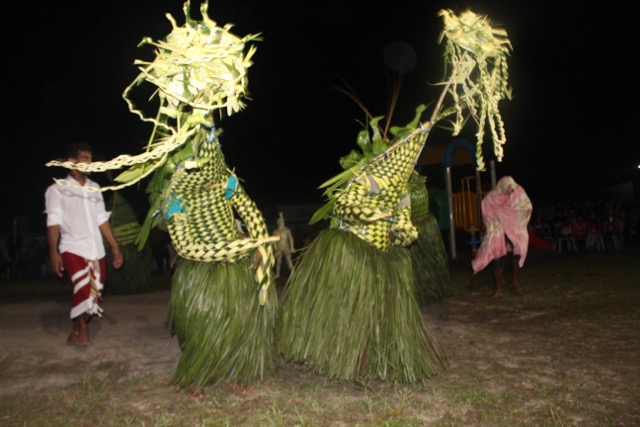
A festival, or sing sing, had also been arranged for us, so while we waited for the officials to make their grand appearance we proceeded with the scheduled event and went ashore for a spectacular celebration – complete with officious introductions, church song and prayer, and the most fantastic tribal dancing we’ve seen to date. The day ended with an enormous feast and contented, gorged bellies. Braca made his usual impact, and I by association had some fabulous encounters with the women and children of the village. As we settled back in onboard Atea that evening we watched as myriad of dugouts scattered off in all directions, families returning to their villages confidently balanced on precarious wooden dugouts with tots tucked under toe. An epic day.

An epic day followed by a difficult committee of government officials who, finally, made the morning flight. Knowing that we were still awaiting clearance, the local representatives neglected to inform us that the festival was not sanctioned without the completion of proper clearance… We’d not cleared through customs, so we were not allowed to disembark from our yachts until processed. After contentious blasphemous bellowing and threat of heavy fine, we were finally cleared into the country – a week after arrival. Welcome Solomon Islands, you’ve already proven to be an interesting place to travel!

Onward we went – from the southern tip we made our way west up the island chain. Tomorrow we will be in Honiara (the “big” city) to replenish our stores and get a change from the village life we’ve been getting accustomed to.

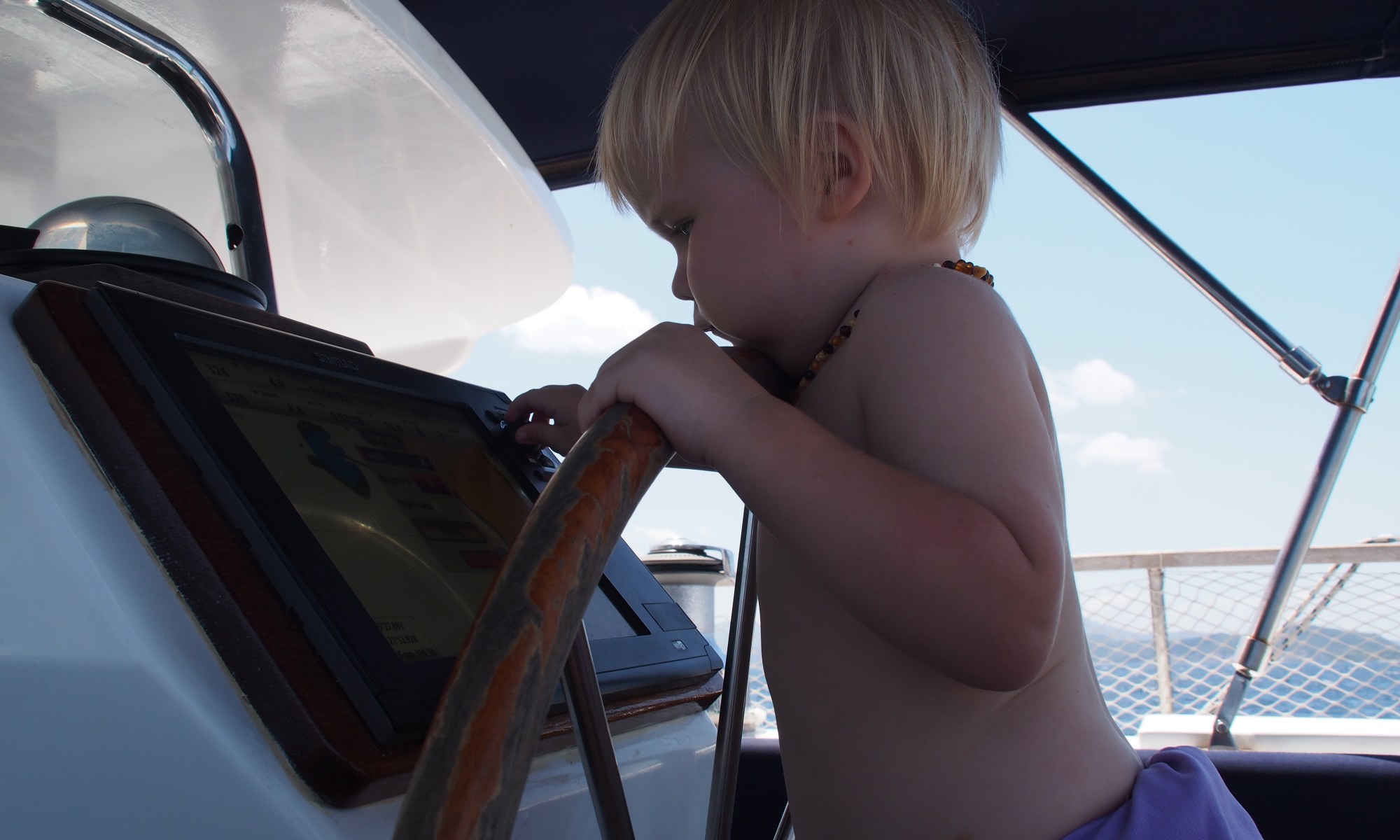
We’ve generally fallen into the practice of sailing by night, our preference with an infant onboard as it is easier to manage Braca’s safety, and increases our own comfort. By night he dozes quietly in his cot with an occasional request for a quick nighttime feed, leaving John and I alone on our respective watches to enjoy a little time to ourselves. By day it is an entirely different affair with one eye to the horizon and one hand on the helm, and the other eye on a very industrious tot with all other body parts trying to keep him in place. An additional benefit of night passage is that it allows us to make progress in bigger bounds and arrive with morning light for reef entrances, leaving us with longer periods of time within an anchorage. Moving by day means less time to play ashore or to relax at anchor, so Atea is becoming a ship of the night.

Highlights of our experiences have been, by far, the local encounters. There are a number of moments that capture this endearing exchange. One that has repeated itself in every anchorage has been the exuberance of the children, their curiosity, and their willingness to interact. I am not used to our boat being swarmed by bodies, but here no sooner does the anchor go down and you are surrounded by children – hanging on a rich array of floating objects, clinging onto the anchor chain, peering through windows, smiling with wide grins. On occasion we’ve offered up our paddleboards for play, with much excitement, and on rarer occasion we’ve even offered to race them in their canoes. We’ve yet to come close as a contender. One afternoon we spent ashore listening to children play a musical instrument constructed of PVC drainpipes, another guided by a collection of children on tour through their village and another to an inland lake. We’ve been escorted to spirit houses that held the skulls and bones of ancient chiefs on beautifully constructed platforms. We’ve sat through discussions with chiefs listening to personal histories and folklore. We’ve had continuous offers of fruit and vegetable, an on occasion fish and lobster, brought out to the boat every day so its been long since we’ve seen the inside of a store to replenish our food. The problem is, however, lack of selection. The items on offer repeat themselves, and our fresh stores have been reduced to pawpaw, banana, coconut, and yam. While the delivery service is superb, we are desperate for a grocery store selection.

Every Solomon smile reveals red stained teeth and gums, chewing beetle nut a favourite pastime for men, women and children alike. I asked for and was given a demonstration by a cluster of women in one of the markets, amid a cacophony of laughter at my curiosity and growing crowd of onlookers. Beetle nut apparently gives a high akin to cocaine, and involves three ingredients to produce the effect. A green nut is torn apart by the teeth to extract a large white nut inside which is chewed to a mush. A fruit resembling a green bean is then broken into a small piece that is licked to wet the end. This is then dipped in a white powder and added to the nut being chewed. The combined reaction turns the white cud into a frothy red that is chewed, spat, and process repeated by continuing to add the white powder and fruit to the mix. The white powder is a lye which is made by collecting dead coral, burning it down to a coal, then pounding this down to produce the white powder – an extremely potent agent that often leads to mouth cancer and early tooth decay.

We are now three weeks into our allocated time in the Solomon Islands. Placing this country as the draw card in planning our cruising route has been well worth it, a quality destination full of the off-beat and the unique. We have just over five weeks remaining before we depart from these treasured isles, and we look forward to the lagoons that lay ahead of us, some say the ‘pearl of the Solomons.’ Our next stint should see us under the water to explore some of the famous under water wrecks that lay in the shallows within Iron Bottom Sounds. We shall keep you posted!

Tidal Flow: The Ebb and Flood of Two Months in Vanuatu

Our intention this trip was to keep the posts shorter and more frequent, this seemed a great plan until we realized how sparse Internet connection is in Vanuatu. The only available connection that we have found is in the main towns of Port Vila and Luganville and as Atea has just cleared customs; we are feeling an urgent need to share some of our experiences.

Vanuatu is comprised of a chain 83 islands (69 of which are inhabited) and in its backbone lies a line of volcanoes which are separated from neighbouring countries by the Pacific Ocean and the Coral Sea. The land here is lush, fertilized by the rich volcanic soil, offering a pristine deep forest that blankets the land. Villages are speckled throughout the foliage, buried from view deep within its organic green layers.

Geology and sociology have had a significant impact in the cultural isolation inherent in ni-Van society. The geological makeup separating each individual island by a deep ocean pass was one reason for the lack of inter-island exchange; the second significant factor was the common practice of cannibalism. With the stakes high, few were wiling to take on these risks in order to meet the neighbours. As a result, inter-island exchange was near non-existent and each island community developed independently from each other until missionaries turned dining on human flesh a taboo practice. You can feel this distinction in each island and it makes each stop an adventurous new discovery.

In reflecting on our time in Vanuatu, we summarize the experience into a short list of lowlights and highlights, our ebb and flood of travel experiences. On the low side we include the list of ailments, injuries and breakages collected whilst in Vanuatu waters of which all four of us (Atea as fourth) are included. As follows:

The first incident occurred when Kia became almost totally crippled after her back went out whilst lifting our healthy – but heavy – baby boy. Bedbound and in serious pain, we celebrated her birthday with a heavy dose of painkillers, anti-inflammatories and muscle relaxants. With the help of this medicinal trifecta and slow, cautious movements we nursed her back to heath and mobility. The upside of this was a take-over from John as main parent and an increase in John’s tasks (other than those that require nipples); as a result, the bond between father and son strengthened and Kia’s boys developed a deeper connection through the process.

The next incident involved a serious breakage to Atea’ rig. The forestay fitting parted at the top of the mast, a major disability in boat terms, and potentially a crippling one had we been going to windward at the time if the break. As fortune had it, we were on a downwind sail and were able to set a temporary mast support, furl the genoa and sail for safe anchorage. Safe in the short term however stuck long term. The broken component was a very specific part of the mast rigging and we were an ocean away from a suitable replacement. We got in touch with a rigging expert in NZ to identify and supply a replacement part for the one that had failed, but because of unreliable interisland mail and obstructive customs officials we were up against another obstacle. The network of individuals involved in connecting us to this particular critical freight became a highlight event. In sum, Greg posted our requirements on Facebook and we were immediately connected to three parties leaving for Vanuatu within the week. Another friend, Emma, collected the part and gave it to friends heading to Port Vila, an island town 300 miles south of our location. We organized with a sales rep at Air Vanuatu an intricate handover from a cargo agent in Port Vila to a stewardess on a flight north, who carried the pint-sized parcel in her hand luggage. From there, we connected with a customer service agent at the airport in Luganville who – by miracle – placed the package in our hands. Kia kissed the woman a half dozen times and headed for home, six hours later, by hitching a ride into a packed tourist van to a petrol station then onward on the back of a lorry with six locals and their assortment of belongings in the dark of the night… but that’s another story.

The next lowlight was John’s infected ankle. What started as a minor blister from a wetsuit boot developed into a fully septic and painfully swollen ankle – a very common injury in the tropics, and one that can be difficult to heal in moist conditions. To be told “avoid water” whilst traveling through foreign waters by boat in the tropics…. For God’s sake, get real! We were again blessed with the generosity of strangers who directed us to the hospital to seek out a specific doctor – who turned out to be a nurse – who directed us to the appropriate parties at a fraction of the standard cost. In a “two-for-one” deal Kia received an x-ray for a chest infection she’d been harbouring for a few weeks, a penicillin butt jab for John’s infected ankle and associated medications. The doctor, a Cuban national, was pleased to entertain Kia’s poor attempts at Spanish when general understanding failed in Bislama and French. We were skeptic that we were being treated for the right conditions given the language debauchery, however a few weeks saw medical improvements and so we carry on with Captain and Admiral restored to a respectable standard of health.

A final entry in this litany of woes is Braca’s metamorphosis from “Angel Baby” by day into “Hell Child” at night. Even parents as proud as we are must admit that our darling son, as adorable in the day as he has ever been, is going through a difficult phase at night. Braca’s physical health is strong and he has sailed (pardon the pun) through these weeks with smiles and laughter, more than his parents at times, and oh, what we’d all give for a full nights sleep. But then we did sign up to the world of infanthood and the blessings Braca brings far exceed these minor discomforts. And of blessings, gifts and marvels, Braca has provided us with many. Since our departure from New Zealand, Braca has gained four teeth top and bottom and sprouted a healthy head of white-blond hair. He has added M’s to his babble for an incessant muttering of “mamamama ma mama,” learned a relatively pathetic crawl and a very competent upright stand. We are now handholding him as he takes brazen steps forward and we all get our exercise in laps around the deck. He is developing a healthy passion for the water in the form of a deck water nozzle, plastic spa-pool, and turtle kicks in the ocean shallows.

He is also learning to be quite accepting of strangers. Young and old, men and women alike show delight when they see our little white boy. Braca is constantly whisked from our arms and taken away by these friendly and family-loving people. While a little disconcerting the first time, we’ve adjusted to losing sight of our son upon arrival at any given village. He’s accrued a lifetime supply of kisses and has a healthy start in the world knowing that he is well doted on by family and stranger alike. Villagers will pinch his cheeks or his thighs and call him “fatty, fatty” to whom I proudly display his routund belly and bulging legs. Fortunately he is too young for a complex and intrigued by the cluster of faces that crowd him.

On the subject of locals, the men deserve a mention for their physique as magnificent athletes. Both men and women alike gape at the hard-bodied men and you can see where they get a solid reputation as warriors. You can also imagine a healthy reputation as lovers when you see the men dressed in the traditional garb of vines and leaves. We visited the island of the Big Mambas and Little Mambas, thus named because of the size of a man’s mamba (penis sheath). John was not averse to visiting the tribes of the “Little Mamba’s” where the penis is wound up in a scrap of leaf tied by a vine around the waist. Despite Kia’s interest, however, a visit to the tribes of the “Big Mambas” was not on the skipper’s itinerary.

While in many Pacific island nations the traditional dugouts have been replaced by fiberglass hulled boats and roaring outboard motors, traditional outriggers dominate the shores of Vanuatu. Men silently paddle up in their outriggers, toddlers underfoot, welcoming us to new bays and offering local produce or a morning’s catch for trade. It is always a pleasant exchange and has often led to invites into the community or their company on deck for an afternoon exchange.

We have also been made welcome ashore within the villages. The ni-Van’s are very friendly, hospitable people and we’ve delighted in the opportunities we’ve had with them. In several island’s we’ve been privy to local dancing and traditional feasts, a local pig invariably served as main course (whose screeches and bellows were loudly broadcasted only a few hours before). We’ve had a unique exchange whereby we were ‘adopted’ into the community by a local family, who offered gifts of woven baskets and homegrown produce. Our ‘sister’ worked at the dispensary and took us on a tour of the clinic; a run down unit in the middle of the bush with little on offer but a rusted metal bed in a overheated cement room and a maternity unit that held stale air, a torn and wilted mosquito net and a cold-metal bassinette for the newly arrived.

Onward in our list of highlights, we’ve been pointed in the direction of human skull and crossbones, the sacrifice unclarified of origin – local dispute, a debt paid, or the last nosy cruiser – and went on a wild hunt for the horrid remains. We were repeatedly reassured that we’d found the site, a secluded bat filled cave tucked up in a small coastal cove, but on clarification the remains have been finally put to rest beneath the sandy surface.

We’ve witnessed the audacious custom of land-diving, unique to Pentecost Island, where men dive from a 60-foot tower to be arrested only inches from the ground by vines strapped to their feet, their head touching the ground in a blessing for the earth and good yam harvest. Another highlight in the category of local custom is the “Water Dancers” of the Banks – grass skirted women who stand waist deep in the ocean and make a tune and beat using only the seawater they are standing in. Who would have thought that water could be whipped, pounded, flicked, scattered and beaten to produce a percussive masterpiece.

We’ve hiked to glistening waterfalls, swam in blue-hole water pools, glided down fresh water rapids – bare rumped and wide-eyed. Of salt-water treasures, we’ve been privy to some fantastic dive sites, namely the world famous “President Coolidge” and “Million Dollar Point.” The Coolidge is a luxury liner that was sunk by an allied-mine during World War II and still well preserved. We were guided through her innards and buzzed with excitement as we floated through ghostly halls and holds, over bombs and ballrooms. Million Dollar Point is an underwater scrapyard from the end of the WWII effort, created when departing US forces left tanks heaped on planes, heaped on ships and jeeps and trucks – all stockpiled at the waters edge on a white sandy beach.

Also worth comment when mentioning deep-sea treasures are the living beasts within the sea. Dugong, also known as manatee, have approached us while on paddleboard and given send-off as we’ve cautiously edged our way through shallow passes. We’ve swum with sea turtle and been surrounded by shimmering reef fish, and even had a five-foot shark take our lure. We were about to wrestle the shark to retrieve our lure on a salvage mission before the line broke – a fortunate event for our intact digits. We’ve dined on delicious tuna, wahoo and fresh lobster – either caught on Atea or delivered to the boat by locals for a trifling sum. Kia’s even been slapped in the face by a acrobatic squid breaking the water’s surface for a quick French kiss in passing.

We’ve sat on the rim of an active volcano and listened to the deep rumble and the firework display of spewing lava – apparently the closest you can get anywhere in the world. I am not sure which was more awe inspiring: Being that close to the boiling pit or the audacious drive up and down the mountain to get there. The drive was an adventure in itself, the truck expertly maneuvered through muddy ruts, near drop-offs and sheer cliffs. Braca and Kia were given the front seat for some false-sense of security while the corralled passengers in the bed of the truck dodged tree branches and held on with white knuckles. The driver became alarmed when we passed two tourists on the side of the road, then settled and made an interesting comment: “It is okay. They will be safe. White people are safe here in Tanna. The Chief told us that they are taboo. ” Well, at least we won’t be served up as dinner in this spot!
And of course, we can’t conclude this entry without mention of Atea and her champion efforts this season. While our cruise last year was plagued by fuel and mechanical issues, Atea has been going well this year and the recent refit seems to have been money well spent. We are well stocked up and living in comfort onboard, aside from the occasional craving of decadent luxuries. The decision to join a rally has provided us with the support and camaraderie that we hoped for, and the group of cruising boats with us provides varied and interesting company. Baby sitters when we need it, drinking buddies when the sun gets over the yardarm and familiar faces around us as we get further and further from our families and home.

And so we conclude our experiences – both good and ‘compromised’ – from our stay in Vanuatu. We’ve recently paid our dues and said farewell to the custom’s officials and so from here we enter the realm of illegal immigrant as we continue our journey northward. For the next two weeks we will unofficially be sailing through Vanuatu waters, stopping in the northernmost group of islands in the Torba Province as we head for the Solomon Islands. As of this morning, our GPS went on the blink and the backlighting has failed us, a significant obstacle in that it renders the screen unreadable. John’s foot continues to seep and Atea continues to weep rust stains down her bow. That said, the sun is shining, the water is clear and warm and we enjoy each day filled with the delight of new possibilities and the potential for unexpected adventures. Stay tuned for our next list of high’s and low’s.

Solomon’s – here we come! Know of anyone heading that way? We’re keen to get replacement GPS brought up in some hand luggage….

Baby Onboard: Braca’s First Ocean Passage

What makes this particular passage of interest to most is the little mini crew member affectionately referred to as “Powder Monkey.” In the 1800’s, Powder Monkey was the term used on war ships for the young boys who ran gunpowder from storeroom to gunnery. While we are void of powder stores and the machinery that requires it, our youngest qualifies as he is fast learning how to scurry about our ship, albeit on his belly.

As all parents know, there are small and large fears that lurk in the recesses of our minds when it comes to our offspring. As wardens of their welfare, it is easy to consume oneself with the “what if’s” of happenstance. While we have marched forward with determination to see our cruising lifestyle continue, it wasn’t without some trepidation that we watched land fade from sight. My biggest fear was seasickness as dehydration in an infant would be a major issue. Given there is 1,000 miles ahead of us on this trip, there would be no fast solution if Braca became ill. My second concern was knocks, bumps and falls, as the last thing a boat at sea offers is a stable surface. I’m sure a different set of parents would have a different list of concerns, but these were my two big contenders when it came to my son’s safety.

I am pleased to say that we’ve come through the other side after confronting these fears to no ill effect. Braca was unfazed by Atea’s osculating surfaces and fair seas left managing him on Atea a rather stress-free affair.

We sped along at 8 knots in quartering seas during our first 24-hours, putting 183 miles behind us in one day. It was a fast sail, and our biggest test during this passage was Braca’s ability to handle the seas. He was, fortunately, the only to appear unaffected. Even myself, yet to be seasick, felt queasy in the big rollers that slopped over our stern side. My number one fear was quelled in the first day – if that didn’t shake him, nothing would.

Fortunately, the rest of the trip has been remarkable from a mother’s protective eye. We’ve had wind on all fronts, so not always ideal from a sailor’s standpoint. The initial southwesterly wind that swept us forward eased mid-passage and turned toward the north finally swinging back around to the west on the fifth day. Though we were the last of the fleet depart Opua by several hours, we’ve quickly made good of the weather and positioned ourselves in the middle of the fleet. We cast our jerseys and woollies on the second day, enjoying the warmth of the tropics as we gained headway north. And so, my second fear was thus appeased by the amicable weather.

Life onboard a ship with an infant requires certain alterations. We’ve baby-proofed the interior so that Braca has a safe spot forward, mid-ship and aft. Our aft quarter bunk has a lee-cloth that turns captain’s quarters into a queen-sized playpen. We have a mosquito-proof baby tent that doubles as his cot that takes up half of the pilot berth, the other side a nappy changing table. In the saloon we have a porta-seat attached to the table, a reclining chair that is cushioned in place on the floor, and swabs that turn the side of the settees into padded walls for a safe tummy-time zone. In the cockpit we have a baby-seat come commander’s chair, and washboards that turn the cockpit floor into a kid-friendly zone. Every locker, drawer, and cabinet is stuffed to the brim with a sizeable collection of baby toys, and the bookshelf holds its own section of Dr. Zeus and Harry MacLary. Add in the stroller tied on deck, a baby backpack stowed forward and the nappies hanging on a line in the cockpit and we’ve fully transformed Atea into a Plunket-approved ship.

Cleaning nappies was a question often asked, and we’ve come up with a workable solution. Soiled cloth nappies are tossed into a mesh bag that is permanently fixed to the aft rail. We hang the nappies over the side for an initial rinse cycle, then they go into a bucket for a fresh water wash. The nappies are cleaner than any of the washing machines we’ve used ashore, which is particularly beneficial as they’ve turned into a permanent fixture in the cockpit, hanging like Christmas garland above our heads.

While Braca isn’t able to give an indication of his particular like or dislike for ocean sailing, he has certainly shown no signs of discomfort or disturbance. Life continues on Atea much as it did in the marina, with the addition of his father as another constant playmate. The added noise of rushing water, the occasional drum of the engine, the constant clatter of the drawers as they open and close to the sway of boat, the pots and pans that randomly rattle about don’t seem to bother him. Surprisingly, he has continued to develop his mobility while at sea, starting to add knees into his forward propulsion and learning, slowing, to crawl. He has also sprouted three upper teeth during the passage so his smile is starting to look less of an infant and more of a toddler, and of course with it, the shock of an occasional bite.

As I finish this we are 50 miles south of Aneityum, just visible on the horizon. We are sailing along at 6.5-7.0 knots, and will be in just before dusk at this rate. We will conclude our passage north from New Zealand in a few more hours and set our anchor down on new shores. Tonight we will celebrate – a toast to the 1,000 nautical miles of ocean behind us and to the first of many islands to come.

Tonight we will also celebrate the completion of Braca’s first ocean passage on his seven-month birthday, Thursday 17th of May.

Opua – A Chaotic Pause

All good trips are best started with great comedy. At least, that’s one way to look at the week spent in Opua. Others might say different, choosing to look at oneself as the fool, but why burden ourselves with such an image when we can claim the character of jester instead?

Opua was intended to be a short, inconsequential stay between leaving Auckland and leaving New Zealand – idle time we expected to spend chumming with fellow cruisers in the ICA rally.  “Rush rush” – the chaos leading up to our departure from Auckland. “Wait” – the pause in Opua while the fleet gathered for the joint departure north.

Our first few days we were kicking ourselves for the mad rush out of Auckland. The ICA itinerary for the week in Opua left a lot of gaps to be filled. As the weather wasn’t going to allow us to depart on our intended date, scheduled events were pushed back and the first few days in Opua were empty ones, filled with our last indulgences: flat-whites and chocolate brownies, last minute tidy-up items on Atea, and a slow lull-about the marina and its premises. Rush rush wait………

The tides turned for us on Thursday, and things got hectic. That morning we filled our tank with duty free diesel, pumping 800 litres into the tank before we noticed diesel pouring into the bilge. Atea was purchased without a fuel gauge so we had a sight-glass professionally installed over the summer to end the continual guesswork and the constant risk of running empty. We were marking the new glass in increments, so we were fortunate to have the floorboards up and were able to see the leakage in the bilge. Had this not been the case, we’d have filled the tank to capacity and sailed off towards the blue horizon, only to realize a few days out that the entire contents had leaked into the bottom of our boat and we were to spend another passage north without a running engine and a repeat of last year’s fiasco.

The following day Atea was put up on the hard, and tucked into the Opua boatyard for her repairs. Fortunately a colleague of John’s had invited us to dinner the previous evening and when Rachael and Blake heard of the change in our living situation we were invited to stay as long as we needed. Being sailors, they understood that a boat in the yard is not inhabitable. A boat in the yard would mean a climb up a ladder while balancing infant on hip, his naps continuously disrupted by electric hand tools, a boat filled with toxic diesel fumes, and a cabin dismantled to allow access the belly of the boat.  We owe  them great thanks for sparing us that particular inconvenience. We’d already confiscated their car keys on arrival, and not two hours after arriving for dinner we confiscated their house keys as well and stayed for a week. Their gracious hospitality was heaven-sent and turned a fiasco into a mini-holiday for Braca and I, and relief to John that we didn’t have to negotiate a boat repair around the needs of our child.

Blake and Rachael – if you read this – again, thank you. Not only for saving our a*%$, but for offering your friendship. I so enjoyed our week together; evening meals and late night banter was such a treat for both of us… not to mention all the indulgences that came along with our stay..

While Braca and I were enjoying life ashore, John was spending full days working in the boatyard. Atea was lifted out on Friday, 4May, then he and a local engineer drained the diesel out, dismantled the cabin floor to access the tank, found the leak (due to an incorrectly installed sight glass), put the tank top back in place, refilled the tank and we were lifted back into the water on Wednesday evening. The departure of the fleet had been pushed back to Thursday morning and we worked hard to get Atea ready to sail with the fleet.

After a very expensive week in Opua, we were finally on our way at 12:00PM on Thursday, 10 May. The weather reports in our favour, we set sail as the last boat in our fleet of fifteen and pointed our ships bows towards her next destination: Aneityum, Vanuatu.

Captain’s Log:

I enjoyed staying with Blake and Rach, but my god, other than that, having the boat ashore in Opua was an expensive fiasco.

Just like last year (when lack of a $5 washer gave us fuel/water problems all trip), this sight-glass repair was one where a small error cost us a huge amount of hassle and money to put right.  If the original installer had put the sight-glass 1 inch lower it would have been perfect, but being 1 inch too high it was above the upper level of the tank and therefore a leak waiting to happen.  It was such an unnecessary expense.

As Kia has said above, the best thing about this whole business is that we discovered it before we departed – being at sea to find all your diesel has leaked into the bilge would not have been a good moment.

I must confess though, there was one comic episode in the diesel saga which was entirely our own error. During the repair, we’d pumped all our diesel into a portable tank on wheels beside the boat.  When the time came to refill Atea’s tank from the portable one, the temporary tank had emptied so quickly that we jumped to the wrong conclusion that all out diesel had been thieved whilst in storage in the yard.  I was in the foulest of moods, bemoaning the Northland locals as we went back to Caltex to buy another 700 litres of diesel – well, it made their day at least.

Back at the yard, we started filling again, and soon discovered the location of Atea’s missing diesel – it was already safely in the ships tank, which was now very full (which is why the level didn’t show on the glass).   I didn’t know whether to laugh or cry, so chose to laugh at my own stupidity.

After reselling the extra diesel at a significant loss, I was done with Opua.  Let’s get going north, let’s get sailing.  As always, it’s a huge relief to drop the dock lines, head out of the channel and put the bows to the open ocean.

At a Turtle’s Pace

We are at the start of our second season on Atea, and so time to get the fingers tapping and some of the stories of recent activity recorded. After the conclusion of our first expedition in September 2011, we settled our waterlogged roots in Bayswater Marina, Auckland, for a Kiwi summer as we charted new territory as a fledgling family.

We were graced with six full months ashore amongst our whanau and I feel such gratitude for our friends and family who’ve turned Braca’s arrival into such a spectacular celebration, and for the support in making our transition into parenthood a smooth and joyous one.  Thank you for all the generosity, the fun, the love, and the connection. In parting, I already look forward to our return!

As the kiwi season turns to autumn, the days get shorter and the nights colder, we prepare for our journey north. Prior to the pace of preparations hitting it’s apex, Braca and I packed our bags and headed for the States, leaving John to do the hard labour. Again, it is my firm belief that most wouldn’t be able to accomplish what John has been able to pull together to get Atea ready for the demands of our upcoming season. Over the past several months John would cast suit as a PM during the day and don grubby garb in the evening as PM on his own personal campaign: Readying Atea for the 2012 season, and whatever lay ahead for us beyond that.

My return to New Zealand was planned around a 1st May departure from Auckland to meet up with the ICA, a rally of cruising boats heading through several island groups together. Braca and I returned to a flurry of final preparations and farewell parties and then the three of us set sail four days later for the Bay of Islands to meet up with the group. Caught half way with poor weather and an unknown amount of diesel in the tank, we sheltered at Kawau and began our feeling of a mad rush to wait. Through the next few days we kept chanting the mantra, “Rush Rush Rush Wait.” We rushed out of Auckland to wait out the weather in Kawau, then rushed up to Opua to find ourselves waiting again. We’d left in a mad dash to arrive in Opua on the dates specified by the ICA to find little activity and another delay in departure due to weather conditions. Rush rush wait. Our intended departure from Opua to Anatom, Vanuatu was planned for the 5th of May, pushed back to the 9th of May, and currently set for the 10th of May. Due to certain unforeseen and unfortunate circumstances, we may not even make that timeline. Stay tuned.

Skippers Notes – “Why is a ship called ‘She?’”

So if Atea needed a quiet summer to rest and recuperate – she got it. Not so my wallet though, and it seemed that our budget for boat work needed to be continually revised upwards.

Firstly, there was the maintenance identified during the trip south – salt water in the diesel meant the injectors and fuel tank needed cleaning, and a valve was installed to prevent future water ingress. The genoa roller furler needed replacement, and the BBQ (washed overboard on the way south) needed repair.

With those vitals taken care of, we turned our attention to enhancements identified during the previous season. The cockpit was often too hot, so we put in a hatch for ventilation. The batteries took a hammering and discharged very quickly, so we replaced those with new ones. Continuing on the electrics, we made a serious upgrade to the solar panels. The new ones are not only ample for our power needs, but we received an added benefit as it casts a significant amount of shade over the aft deck where we spend much of the time.

Since the little stowaway is now out of the oven and increasingly active we’ve installed a travel cot and tie downs, and seemingly every drawer I open is filled with toys to keep the boy entertained. We also have a 30-meter roll of safety netting to install later in the passage. Since Braca is just beginning to crawl, we must tie the netting around the guard rails before he learns to move too fast. To keep the grandparents (and other interested parties) informed of Braca and Atea’s progress we upgraded the electronics so that we have the ability to send and receive emails at sea, which will also allow us to update our position on the blog daily.

To keep the adults entertained, we added a new stereo and cockpit speakers, so can now crank up the sounds and frighten off the seagulls. Santa provided a clever new VHF radio, so hopefully our cruising colleagues can hear us too. Legislation in Singapore waters requires us to have an AIS transponder… another $800 gone. The alternator needed reconditioning, the mainsail has been serviced, the water pumps needed replacement and so the list goes on. Those who own boats will understand this, and the old adage of “a boat is a hole in the water into which you pour money” has never seemed more apt.

And finally, in the week before departure, we’ve carried onboard six vast shopping trolleys of stores – aiming to have all the basics for a seven-month voyage. Unlike last year, we are also well stocked up with grog. The tins, bottles and bags have finally disappeared into lockers, bilges and other secret stowages, and I think we’re ready. With all this weight of food, fuel, water and wine, Atea is lower in the water, but I think she is in good shape and her systems are enhanced to keep the three of us in safety and comfort. It’s time to go. Time to stop spending money, and start sailing.

Post script: We found a leak in the diesel tank five days after leaving Auckland, so Atea is in the boatyard for repairs. I am reminded of the following quote: “Why is a ship called ‘She’? Because it’s not the initial cost that breaks you, it’s the upkeep.” We are feeling this acutely and hope there are no more delays before departure.

Baby Braca Tai

Our little stowaway has finally come on scene! Born on 17 October, 2011, he greeted us at 8:10AM at 3.4kg/7lb10oz and 20 inches. Welcome our little powder monkey!

Click here to see the first few months of this little sailor’s life.

Friends and Fanfare

If I am to break down our time in Fiji into stages, I see three distinct segments. The first was as sailors within the cruising route, the second as intrepid explorers on the cultural route, and the third as tourists enjoying the “postcard Fijian experience.” All three are worth their weight in gold – or for a more nautical expression, worth their weight in salt – for what each allowed us to experience.

And so, we spent our final weeks in the company of good friends, based in Musket Cove and exploring the Mamanukas in more detail. Our first impression of this chain had been one of dismay, far from the explorative travel we were hoping for. However, on closer examination we found it to be a charming collection of anchorages, once away from the resort hubs. We experienced some of our best diving here, some stunning scenery, remote islands and a few scattered villages. We spent a wonderful couple of weeks discovering these pearls, as well as simply kicking our feet up poolside and indulging in all the luxuries of resort accommodations.

We had two sets of friends join us during our final days in Fiji. I comically define them as the “child haters” and “child lovers,” though both an exaggeration in descriptive label. This was because, after a season of travel where I was pretty isolated from feedback and influence concerning my pregnancy, I now shared time with friends who were both curious and interested in our child-to-be. This brought with it resolution on feeling blessed to get the experience of motherhood, and fear of the demand of what that actually required.

Where our first guests had made the active decision that having children was not a course they would choose, the second were enjoying their second year of parenthood. Our so-called “child haters” highlighted all the things around us that would limit us, demand of us, exclude us from. Ironically, this solidified for me the feeling that I had done all that I wanted to do without children, and this next step in life would be my next big learning curve – my next big adventure. Now, they weren’t really child haters per say, and to be fair Dena and I spent a number of wonderful moments talking theoretically about children and motherhood. It was the first time for me in all of my pregnancy that I had an outlet for these discussions, and I cherished it. It was good female bonding as well as time spent thinking in depth about a world I know nothing about. Alice’s tunnel – I am about to tumble through! I truly hope it is a Wonderland.

Our second visitors, following directly after Nick and Dena, were our “child lovers,” who were bringing their two year old to give us a taste of reality! Now, I do have to say up front that Max is one of the easiest children I have met, adorable, well tempered and in what I am sure most would say, a parent’s dream child. So, with that stated, I still felt exhausted watching the amount of energy it took to occupy the curiosities of a toddler… and to keep up with such a bundle of energy. There were a few moments when I looked at John and said, “I can’t do this!! I’m exhausted already and we aren’t doing any of the work!!!” – that, after ranting at length on the blessing and beauty of parenthood a week prior!

The time spent with both couples was wonderful, parenthood apprehensions aside. We got to explore some new territory, find some of the most beautiful corals and bump through vibrant schools of reef fish, watch sunsets over some of the most glorious remote islands and skip along long stretches of white sand beaches without sight of another human form. And then we indulged in the complete opposite; body messages, coconut cocktails, infinity pools, fresh seafood, entertainment that required nothing of us than to kick back and enjoy. It was the perfect conclusion to our cruising season– spent with good friends surrounded by luxury and indulgence.

John and I felt that we had experienced a wonderful mix during our time in the South Pacific islands. We were now prepared to return Atea to home base and welcome the next phase of our relationship, and our next adventure.

One last story before I conclude Atea’s 2011 South Pacific voyage. I stayed in Fiji four days after Atea’s departure for New Zealand so that I could help provision and prepare Atea for the delivery trip. We had accepted a request by a German backpacker to join on the passage south, and so a few days before departure we brought Toby onboard as crew for the delivery. That way John had a second onboard to help with shifts, Toby had a ride south, and I could escape passage duty guilt-free knowing that John had a second pair of hands. As we said our farewells, John’s last words to me were: “Stay safe while I am gone – and make sure you make it to the airport on time!”

Well, I’ve never been one to follow someone else’s command.

After their departure, I checked into a seaside hotel and prepared to relax and pamper myself through my last few days in Fiji. I looked quite the sight. A solo pregnant woman didn’t quite fit the ideal picture. I am sure the rumours amongst the staff and guests circulated – an abandoned woman left in her final stages of pregnancy. How sad. The poor woman. How miserable she must feel….

One day passed and I defaulted on my promise to John. “Stay safe.” Right. In the late afternoon I took a walk around the neighbourhood to get a bit of exercise and was attacked by a stray dog. Charged by three, one decided to break the “stand-off” and lunged for my ankle, puncturing my skin with his four canines. My first was response was incredulous – “what do you think you are doing, you stupid dog?!?!” That quickly turned to panic as the dog made a second lunge. This time I screamed at the top of my lungs, “GET YOUR F@#*ING DOG INDOORS!” F@#*ING F@#* F@#* F@#*!!!

The shriek brought neigbhours to my rescue. As they scattered the mangy mob I hobbled down the street to safety, tucking into a bush to inspect my wounds. I had blood pouring from ankle to foot and throbbing pain mixed with panic – rabies? Just what could this mean at this stage in my pregnancy? Was the baby okay – forget the foot!

I spent several hours at the hospital, a jab of tetanus in my butt and medications to stop infection. To pull some good from the event, I got a pregnancy checkup confirming all was well with bubs in the belly.

I chose to fly two weeks after the airlines cut off for pregnant women. The rules dictated that I would not be permitted to fly five weeks before my due date; I’d book for three weeks prior. Hell, what fun is life if you don’t push the limits?! Regardless, I felt I was running a stroke of bad luck and I didn’t want that to carry through to check in. So, I told my story to the doctor and with a little nudge and wink, asked if she could write me a “doctor’s note.” Now, in New Zealand or America I wouldn’t dare suggest it with fear of lawsuits and legal ethics binding doctors tight. But hey, this was the islands – and rules tend to be a little more negotiable. We plotted an acceptable term, and I walked out with a punctured butt, a bandaged foot, and a doc’s note that said that I was 32 weeks pregnant. I received my “get out jail free” card, and I was getting on that flight to New Zealand!!

Skippers Diary – Fiji to NZ Delivery

Day 1 – Just outside Musket Reefs, Log reading 20 miles, distance to run 1250 miles, wind SSE 15 knots

After all the hassle of custom’s and provisioning and fueling and checking weather and preparing crew and filling water, of packing up the boat and stacking the dinghy on deck and all the other preps that go into a departure, it is always such a relief when the ship’s bow is heading for open ocean and all you have to do is sail. I feel this every time I put to sea, but today is tinged with a new feeling; sadness and emptiness.  Kia is not here and I miss her already.  Despite all the logic about her not being onboard and going home safely by plane, it just doesn’t feel right to not have her with me. I feel like a part of me is missing.

The exit from the Fiji waters was pleasant. We sailed out of a narrow channel about an hour before dusk, and the boat was going well under full sail and a 15 knot beam reach. There was a kiter enjoying the evening, in the same spot Nick and I were kiting only 10 days ago, so it’s a fond farewall to Fiji as we head out into the open ocean and the first night.

Days 2 and 3 – first 300 miles, distance to run 950 miles, wind SSE 20 knots

I’m writing this later since I was in no state for diarising over the first 48 hours. Both Toby and I have been seasick, eating nothing and very low energy.  Watch handovers have been literally a time for handing the bucket over and exchanging little else. It wasn’t until the end of Day 3 that either of us were able to keep any food down, but noodle soup and crackers and water are gradually becoming attractive and staying down where they should.

Atea, however has been sailing strongly – the winds that have made for rough seas and clenched stomachs have given the boat a good boost. We’ve been sailing at 6 to 7 knots under staysail and reefed main only, with 20 to 25 knot winds fine on the port bow.

More worrisome, however, is that water now appearing in the fresh fuel that we purchased just before leaving. This has to be removed at the filters and I’ve spent a few unpleasant moments tending to this in a hot heaving engine room. After the saga of water contamination on the trip up to Tonga I’m damned if we’re going to have the same problem here. We will just keep on bleeding the water out at the filter until it runs clear.

I miss Kia and wish she was here to look after me.

Day 4 – Log reading 380 miles, distance to run 900 miles, wind variable

The day started well, with a 3 sail beam reach and Atea charging along at over 7 knots across seas that seem to be easing. We’ve both had Weetbix for breakfast, and my body is feeling fitter and stronger again.

Mid-morning – as the wind continued to rise I’ve had to take in the genoa since I’m worried about the state of the roller bearings. Our speed has dropped from over 8 knots to 6.5, but although this is slower, it’s safer and ocean passages are about getting boat and crew there in one piece.  This is why I’ve never been interested in ocean racing –  it seems like two incompatible activities to me.

PM – the good moring has turned to a very poor PM.  The wind gradually moved further and further to the south so that we have been left with a SW 25 to contend with. I expected some bad winds, but not so soon and not so far north. Real slow. Auckland seems a very long way away at 3 knots.

Day 5 – Log reading 450 miles,  900 miles to run, wind SW 10 knots

Midnight – ugh, more fuel problems and the filters were full of water when I checked. We’ve had the motor on to try to keep some progress against these F**%^ king headwinds. I hate these situations.  It teaches you patience, and some might say its beneficial. I bet none of those people have been here crashing up and down for 24 hours.

I’m very tired since I have to check the fuel filters every hour. Every now and then I find one of the little notes Kia left around the boat. Such sweet little comments, they make my heart leap and I smile. But like an addict without my drugs I’m soon wanting the real thing. I don’t wish she was here with me; I wish we were both somewhere else.

Both headfurlers seem to be u/s.  We had to unroll the staysail manually and I’m worried about how to manage those sails when we get into the strong winds that we will surely encounter near NZ. On a sailboat there are so many little things to keep track of,  how much simpler would it be if someone else was looking after all these items? Next trip I’m going to be at 40,000 ft with a Gin and Tonic.

Day 6 – Log reading 550 miles, distance to run – 650, wind variable

We spoke with NZ radio last night to pass over a position report and listen for any updated weather comments. They told us that favourable winds were coming and we’ve just persevered all night as the headwinds gradually faded away. We’re left with a calm and have been motoring across it for 24 hours now.  I don’t mind burning up all that dodgy Fiji diesel and most of the water seems to have come out of it now.

With the calm has come sunshine and a general chance to catch up. We are half way, and have had coffee and omelette, a morning shower and a pleasurable day. I’ve rerun the main reefing lines so that we can put in the 3rd reef if needed in the strong winds that I know await us further south. It’s nice today and I love it out here.  Tempted to stop for a swim.  We needed this little break, even if it is ‘the calm before the storm.’

Day 7 – Log Reading 670 miles, distance to run – 520, wind Wly 20 knots

Well, it was the calm before the storm and we’ve been in some thick weather for 24 hours now. The wind started building from the NW by late PM, and we were moving along at a good speed by midnight. The wind has built further to 20-25 knots from the west and we reefed down to match, finally getting some good fast progress to the south and bringing Atea closer to loved ones.

At about 7AM today we passed through the front of this system – 30 knots of westerly winds and heavy rain; I was out to take in the 3rd reef and got soaked and cold. Tiring as this might be, it’s nothing compared to the task we had to do two hours later. I had to climb the mast – this is a dangerous task at sea in these conditions – but it had to be done since the running backstay had popped out and without it we cannot set our small headsail.

We hove-to so that the boat was as stable as possible and I put on my kitesurfing helmet and impact-vest on for bodily protection (designed to absorb shock and impact when  kiting stunts go wrong). If the climb went wrong and I was thown loose of the mast, the chance of injury would be very high and could end in cuts, bruises or worse.  In the end, the task went relatively easily. I reached the top without too much problem and refitted the stay whilst clinging on tightly as the mast gyrated wildly in the rough seas. With the mast now properly supported, we could set our small staysail which is our best heavy weather sail and roll up the genoa.

Rolling up the genoa was not so simple either. My earlier worries about the furler bearings were well founded,  and the furler is now u/s so I had to go to the end of the bowsprit to roll up the sail by hand. There will be no more use of this sail until we can repair the furler in Auckland. After having been to the top of the mast and out on the tip of the bowsprit,  it was only fitting that we should have one more drama at the other end of the boat. To finish off this morning with one final drama, the BBQ had been swept off by rough seas and was dragging along in our wake, held only by the gas hose. Luckily Toby was able to save it and lash it on board again.  Another job for the repair list when we get in – we can’t have a good Kiwi summer without a functioning BBQ.

All day we’ve been sailing along in sunshine but very strong westerly winds. Looking out to sea, one sees line after line of white rollers and heaving seas. Atea is riding well and we’re making good progress, but it’s a sobering sight to see such a vast ocean and endless array of breakers all coming our way. Toby is learning quickly and becoming a very helpful person to have on board, but he did admit to being a little scared last night and I can understand why. For my part I’m not scared, but I do feel vulnerable and it feels as if we’re being tested by the elements. I just want my boat to hold up without any more breakages, my body to keep warm, strong and uninjured, and my spirit to give me patience and courage to get through this.  I am very glad Kia is not here and also glad that I am getting closer to her with every mile.

Day 8 and 9 – Log reading 900 miles, distance remaining 400, wind Wly 25 knots

Groundhog days – still blowing 20-25 from the west, still bouncing our way south, still hanging on, doing our watches and passing the time. Changed the trash bin tray today – is that as exciting as its going to get?

I’ve been reporting to Russell Radio every evening with our position, course and speed.  They give us an expected weather for the next 24 hours, but today they also had a message from Kia.  She’s in Auckland (good news since we were worried about getting on the flight in her 9th month), and the ultrasound went well.  Bubba is healthy and, most importantly, “still in the oven.” Little titbits of news like this make me happy and sad at the same time. Good to hear from her, but it makes me want to be there rather than bouncing about out here.

The winds eased a little to the west which has made our­ progress southward pick up pace and we’re doing 5 to 6 knots straight down the line. It’s bouncy and cold but sunny. Things are getting quite wet below and we’ll need a good few drying days when we get in (Auckland in the spring?? Huh!!).

Toby has grown into this – he is standing a good watch, putting in and taking out reefs, and an asset to have on board. He says he loves the “great learning experience” but he keeps asking when we will see land; I think is as keen as I am to reach Auckland.

Day 10 – Log reading 1050, distance to go 180 miles, wind SW 20 knots

Major blow today – the engine has stopped. I’m 95% certain that it is the water in the fuel that has been nagging us since the last fuel fill. I could kill those Vuda point suppliers who gave us this dodgy diesel, such a waste of money – not to mention the extra stress and hassle. The only good news from our previous fuel woes (see “All for a $5 Washer”) is that I’ve learnt a lot about water in the fuel and I’m pretty sure that I can fix it and get Lucy running again. However, I need to have flat water before I’m going to get too far into that job. It is another unwanted complication for our last 24 hours.

The good news is that our progress is holding strong. We are now 45 miles east of North Cape and should make landfall on Cape Brett tonight. Then it’s just 120 miles down the coast to Auckland, things should be calmer as we get closer in so I’ll try to get the engine going then.

Soon I will be in cellphone range – can’t wait to ring her!

Day 11 – Log reading 1300, distance to run 50 miles, wind Wly 15 knots

This will be the last entry since we are only 2 hours out of Auckland.  We’ve been in the shelter of NZ for the last 24 hours, and man o’ man does it make a difference to the sea state and the level of comfort on board. Toby and I are washed, dressed in dry clothes and waiting to get ashore.

I had to empty about 100 litres of murky water out of the fuel tank and clean/prime all the filters, but the engine is running again. We hand-steered last night through a calm moonlit night down past the Northlandcoast – quiet, beautiful, but my god its cold. This morning the sail across Bream Bay was glorious with 15 knots wind on the beam, 3 sails set, and Atea romping home at top speed. Dolphins played under our bowsprit – the very same welcome that I had on my first entry to NZ, by sail, nearly 20 years ago. I love NZ, and returning to this country is always a pleasure, always makes me feel at home, and always makes me appreciate the beauty of life and realise how lucky I am.

Re-reading this log, it paints a fairly gloomy picture – seasickness, headwinds, cold, rain, boredom, frustration, mechanical failures, crashing waves, dampness, etc. In truth, when we realised that we’d have to return to NZ at the tail-end of winter, we expected a tough voyage and were even told “Don’t do it – leave the boat in Fiji and wait until December.” In recompense for the low moments are the times when you stand on the deck of your yacht approaching landfall, knowing that she and you have done everything that was asked for.  I’m bursting with pride at this tough little ship – she has taken a beating from the weather, but she has fought her way to safe harbour; she has protected her crew and delivered them safely to their loved ones without mishap. She deserves to rest in quiet harbour, to dry out, and enjoy a calm summer in preparation for next year’s adventure.

Who Pilots Ships

Who pilots ships knows all a man can know of beauty,

And his eyes may close in death and be content.

There is no wind to blow whiter than foam white wind,

And no winds breath sweeter than tropic wind.

There is no star that throbs with cold white fire as north stars do.

No golden moon path lovlier than the far path burning on the sea when the dusk is blue.

There is no rain so swift, as rain that flies in bright battalions with a storm begun

No song that shakes the heart, like amber cries of gulls with wings turned yellow in the sun.

Who pilots ships, when life’s last heart beat stop, has drained the cup of beauty drop by drop.