Bicycle Spokes and White Rice

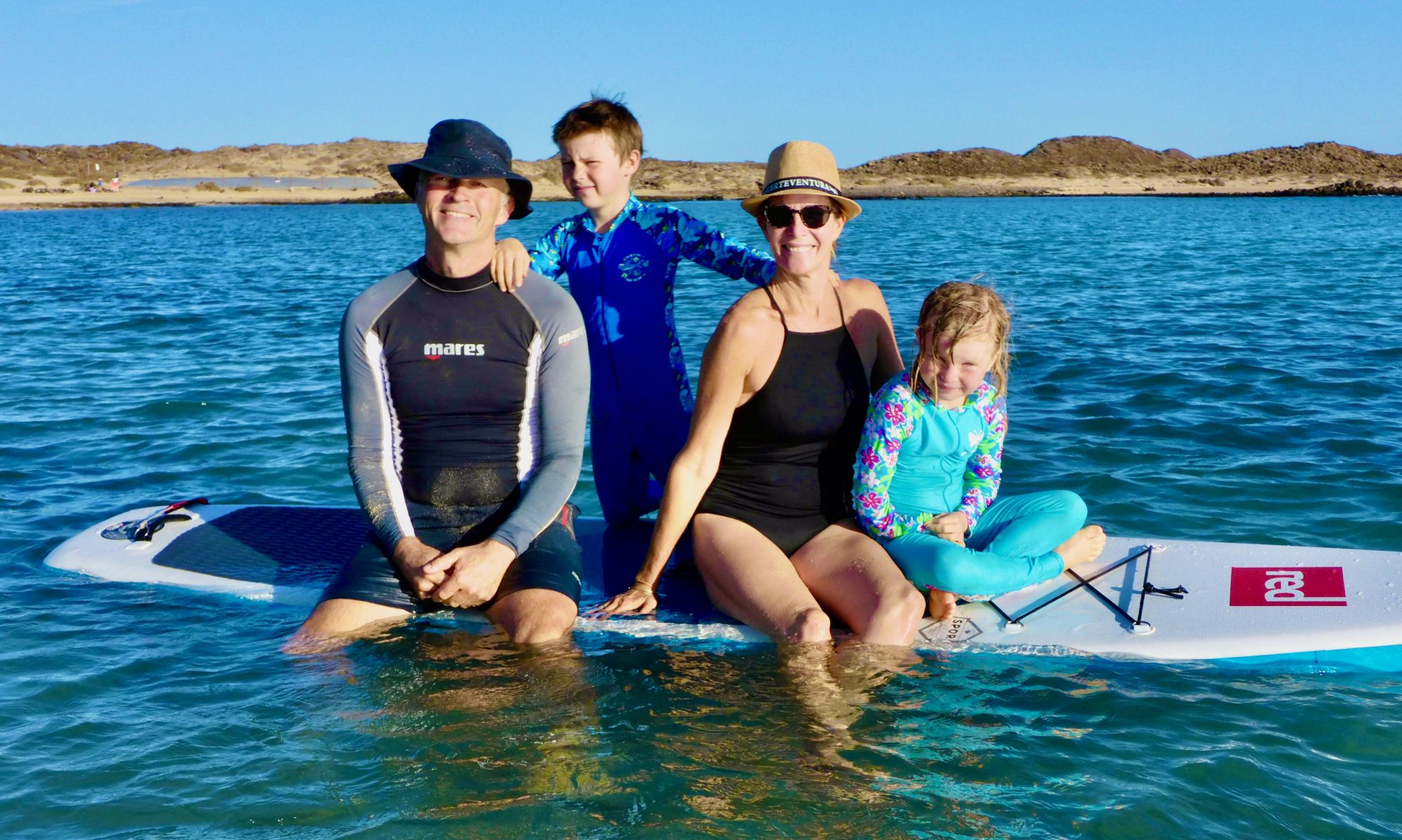
We can now officially report that we have “gone cruising.” Dock lines were cast yesterday and we spent our first night at anchor. If feels rewarding to be truly afloat again, with bows pointed to the breeze and salt spray cast across her decks.

It is hot here in September – low 30’s hot, which when breezeless means really, really hot. Matters are worse when smoke fills the sky from burning plantations of palm trees, making the heat seem all the more oppressive. It has taken us some time to adjust to the high temperature but the gauges are tuning and our bodies starting to regulate. We initially stayed in a hotel near the marina whilst Atea was on the hard getting her final work done, the air-conditioned rooms a welcome reprieve. We soon discovered, however, that air-con in these parts don’t have temperature adjustments so we either battle hypothermia or heat exhaustion. I’ve never understood why countries with the hottest temperatures tend to turn their thermostats the lowest – it has always seemed counter-intuitive to carry jumpers around when walking around in the blistering heat. But if you intend to spend anytime indoors the extra layers are necessary. I now understand how Muslim’s can get away with head-to-toe covering when I spend time indoors shivering myself blue.

It took us three weeks to get ourselves sorted for the season, which was the timeframe we expected. While Pangkor may not attract the average tourist, Pangkor Marina does offer a good base to get marine work done. We had high hopes of getting a significant refit done to Atea during her nine months on the hard, but we soon realized that you have to be present to ensure progress. Nevertheless, we succeeded antifouling the hull, polishing the topsides, painting rust spots and the interior woodwork has been rejuvenated. At the last minute we added in an anchor winch service, rudder shaft repairs and a leaking hull valve replacement. After emptying out the bank account, we were finally ready to go. You quickly realize why boatyards are full of foreign cruising yachts. With prices roughly 50% lower than western yards, it is the only place you can afford to have work done… and even then boats quickly consume what money you have.

Of our diet, it has changed considerably since re-embarking on the cruising life. As I reflect through the seasons, the taste and flavour of our meals are highly influenced by the regions we travel through. This one more so than any other. In previous years we have left shore with a yacht stocked for extended periods. Rather than a year of stores onboard, this year we have the luxury of easy access to most foods and we are able to provision as we go. A novel experience. For the first time ice-cream blesses our freezer, which sounds a good thing as in years past the entire space has been jammed exclusively with eye fillet and scotch steak. However, while fruit and vegetables abound, quality meat, breads and cheeses are sparse. The chicken is scrawny and the meat ordered by hue: orange, black or green. As such, a vegetarian diet consumes our meals unless we go ashore. Given meals – good, delicious, full-flavour meals – are a quarter of what the ingredients would cost, eating ashore is a regular affair.

That’s great until you are blessed with a toddler who has little appreciation for spice. As meals in Malaysia are a blend of Indian and Malay culture, very little is served bland in nature. Given Braca’s distaste for meals with a red hot kick, rice is slowing becoming his staple. Ayla is getting her balance of nutrition through breast milk, but Braca has been abruptly deposited into a white rice diet.

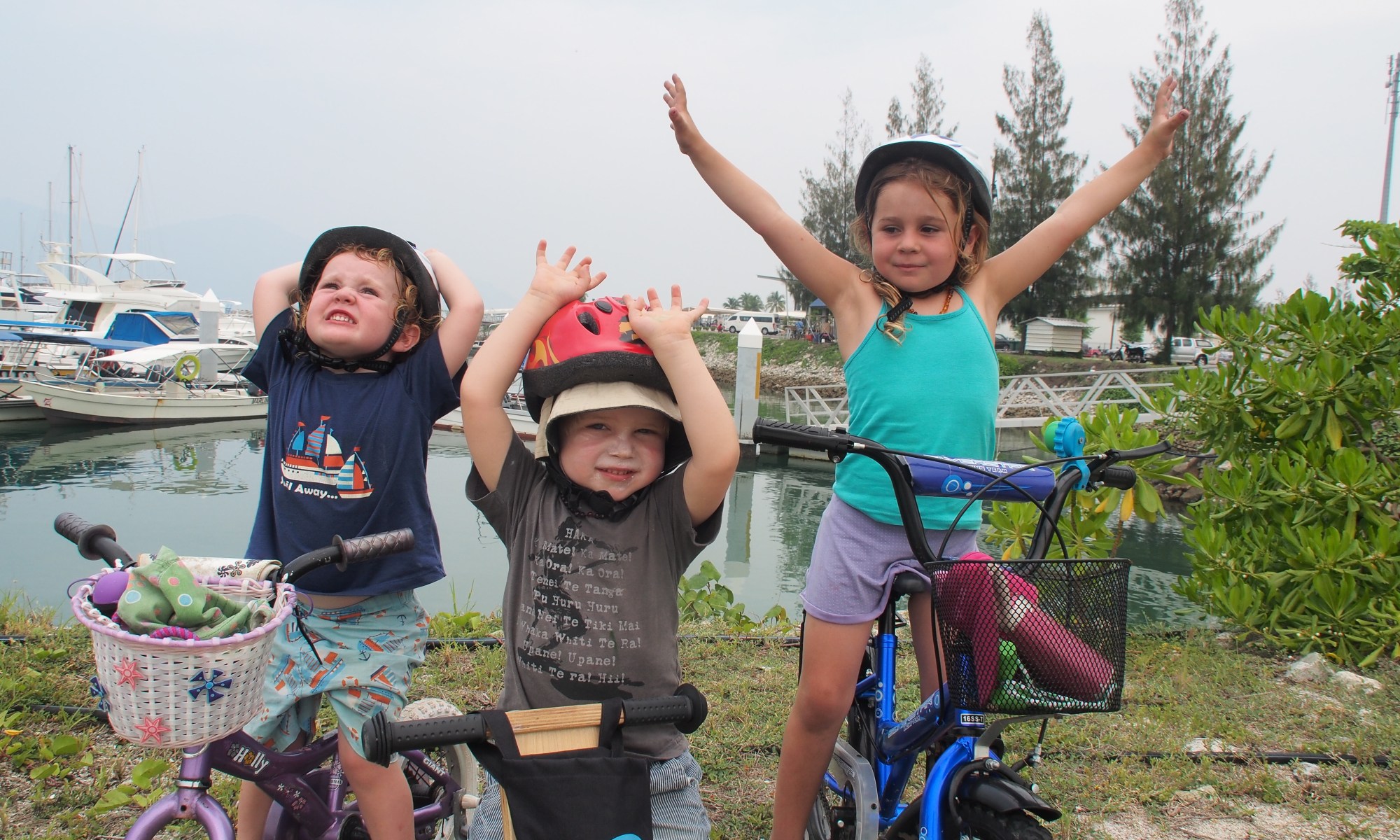
We lucked into good company on our first day. We went to the boatyard to greet Atea for the first time in ten months when we saw two small figures madly peddling along the walkway. To my delight, they turned down the ramp to a yacht at the end of the jetty. I went around to introduce myself and was delighted to meet a very chatty and warm Canadian woman and her Australian family. Her two daughters are two and five, the youngest a month off Braca’s birthdate. We laughed at the kit that comes with kids and how ridiculous some of it was in a cruising context – babies on boats with bikes. John and I had debated before leaving Auckland at how ridiculous it was to bring a bicycle and trike (for the baby who isn’t yet crawling!), but this introduction started a ritual of morning communal bike rides and an immediate friendship. “Where are my girls?!” was the first thing Braca would say in the morning and they’d soon be off as a connected threesome. They would be off peddling around the marina, swimming in the hotel pool, hanging out below decks playing games or attending home-schooling lessons. We also took excursions into town, which provided access to local attractions and activities. SV Wandoo made the three weeks in Pangkor Marina a very social, welcome affair.

We have reunited with old friends and met some new, and social evenings on the aft deck have kicked in to a regular affair. What stands out is that at some point in the evening all conversation inevitably turns to “where to next?” Opposed to seasons past where routes all led westward, piracy in the Indian Ocean means that cruisers have to choose alternate plans to what was once the “milk run” to the Med. From Malaysia and Thailand, most boats head southwest through the South Indian Ocean to round the Cape of Good Hope in South Africa on a return trip to Europe or the Americas. A few brave or foolhardy team up to head through the Bay of Bengal and the pirate waters of the Arabian Sea (or finance the safer but more expensive option of shipping the yacht by cargo ship). Others look eastward on a circuit that leads them back through the North or South Pacific. Us? We have no idea. Or more aptly put, we have many ideas but none that we have committed to.

Sight and Taste of the Spice Islands

[As we prepare for this cruising season, we are tidying up from last season: Here is an update from July 2013 that covers the first few months of our trip through eastern Indonesia.]

In deciding to join the Indonesian rally this year, known locally as Sail Komodo and internationally as Sail Indonesia, we chose to do so not because of its logistical perks but for its social benefits. Indeed, the rally does assist in organizing visa permits and extensions. It organizes immigration and customs visits and the like which saves on the hassle of sorting it out individually and the runaround you often get outside of organizational sponsorship. However our key drivers were much less serious than all that; we wanted rum-buddies & poker-pals to share anchorages with along the way. With 105 yachts signed up for the rally, we were certain there would be a few like-minded comrades that we would be able to join up with.

One hundred and five is a whole heap of boats; about one hundred more than we were interested in joining in a poker match. Fortunately, the rally had organized two route options. Option A followed the traditional cruising route and had the majority of participants. Option B was on the ‘road less traveled’ and had received much less interest. When we first discovered the ratio of 6/99 we thought we’d clearly missed something. We spent a day doubting our choice however concluded that nothing could be worse than following a hundred boats around a cruising circuit. When the Indonesian Government laid down incentives we spent a second day debating what we’d missed: $250 in cash and $250 in diesel to switch, but the offer had only persuaded six boats to defect. One follows the tradition route along Flores, the other strikes north to the mythical Spice Islands.

Our decision made, we readied Atea for departure out of Darwin on the 27 of July, two days after our beach wedding. Our route would take us north to the Spice Islands in eastern Indonesia, westward through the little-known diving meccas of Wakatobi and Takabonerate, through the province of Buton and then southwest to rejoin the fleet in the world-famous Komodo Island, land where ‘dragons’ still roam.

After a three-day, rough but fast passage north from Darwin, as we set thankful feet ashore in Saumlaki, our first stop in Indonesia. Two things were immediately obvious: We were welcome guests, and this was no casual cruise. Upon arrival we were quickly wrapped up in a list of welcome ceremonies and official functions and as official guests of the state. Second, the Indonesian people were delighted to see us. As a step off the beaten path, locals were unused to foreigners and Saumlaki is far from a tourist destination. “Hello Mr., Hello Mrs.!” sang out in our ears along with the constant peeping of horns from countless motor-scooters, signaling a warm reception.

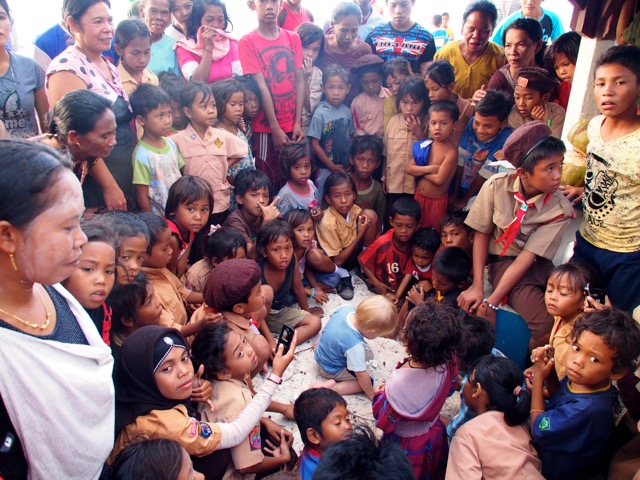
While we were used to Braca being a novelty in placed we’ve traveled, Indonesia is a busy populous country and he was swarmed in mass. Braca was bombarded by pinching fingers and phone cameras every step of the way, and he was quickly overwhelmed by the attention. Our poor little trooper was swamped in attention from adults and trailed an ever-growing crowd of kids wherever he went. The locals have a habit of touching or pinching the cheeks and flesh of babies they admire, and whilst Braca stoically endured this constantly, being picked up by adults became his do not cross line. Last year he was gently loved by the Pacific Islanders, but this year his patience had found its limit and he adopted a new habit of screaming his annoyance if picked up by an enthusiastic local. We coined the term “Braca-razzi” from paparazzi for the crowds of photographers who surrounded our son, and whenever the Brac-Pac was in pursuit we followed closely like security guards.

Braca was not the only youngster to be intimidated, however, as we quickly learned that the screaming babes and toddlers running for the protection of a mother’s skirt was due to our whiteness – it was the first time that these young ones had seen blue-eyed, yellow-haired humans. It made me appreciate just out “off the beaten path” we were.

After a week of official welcome ceremonies in the gusty deep-water anchorage of Port Saumlaki, we headed for a quiet stop only 20 miles up the coast which provided an insight to rural Indonesia. We anchored Atea off a beautiful sandy beach and took ourselves in to play on the white sand; before long a few of the villagers who’d spotted our mast wandered down to investigate. As children go, Braca immediately had playmates and we sat with the elder who shared with us stories about his village. We were taken to some charming washing pools in the forest and watched the children splash in the water and the women scrub clothes on the rocks. As the sunlight trickled through the thick canopy overhead, we felt the magic of the moment and the beauty of these cultural exchanges – this was what the lifestyle was about for us, unplanned and spontaneous.

From there it was another overnight passage to Banda Island, center of the lucrative nutmeg trade 200 years ago. Such was the importance of the nutmeg trade that the island was once swapped by the colonial powers in equal exchange for nothing less than Manhattan Island. Today it is a small, quiet but pretty town that sits in front of a towering volcano with a deep volcanic crater that provided us safe harbour. We were anchored stern to the shore alongside our new cruising partners, making new friendships as we adjusted to the dynamics of the rally. Banda has clear waters and great diving to offer, a volcano to climb and a town rich in history so our days were kept full. John took the two-hour hike up through thick bush to the summit of the volcano and was rewarded with a glimpse into the smoking crater, commanding views of the ocean and a sore knee that has not been the same since.

Wakatobi and Buton, our next two stops, lay at the end of a three-day passage westward and showed us the ethical dilemma of the rally. As a government-sponsored event, townships vied for the ability to host the rally and took on responsibility for events and activities to entertain us. It appeared to us that each town tried to outdo the last, as events became grander as we continued onward. Wakatobi offered us fuel and cash to visit and we were not too shy to decline the offer. Thankfully, the warmth of our welcome and the richness of the local events meant that we did not have to question whether acceptance of a gift imposed an obligation – we were grateful to accept both. The feast provided at Wakatobi was fantastic, local dance professionally delivered with plaques and traditional dress offered to us as gifts. Local events were hosted each day and free transportation provided at our beck and call.

Buton posed a slightly different problem, as it was a remote province that was not visited by foreigners and to get there added distance in the wrong direction. We were visited by the governor of the province with a direct plea that we attend his township’s festivities as they had spent six months preparing for our arrival, the “Dance of 12,000 Virgins.” While we had plotted to bypass this in search of some solitude, we felt the pressure to attend – of course we didn’t expect to actually see 12,000 bodies on stage however that is exactly what was delivered.

We were honoured guests to a traditional takoki, which translates to “giant dance.” 12,500 school children had spent the better part of a year preparing for the choreographed dance, professional musicians were brought in and the media was present. We were given “box office seats” in a decorated, designated area – the only covered seating offered to the public. I assume they were expecting a more even distribution of the 100 rally boats, but as there were only 12 yachts on this route the distribution was 1,000 dancers per visiting boat. We felt humbled that so many people had put in so much effort to be part of our welcome, but as the music boomed and the superbly drilled dancers flashed colour and movement as far as we could see, we couldn’t help but be absorbed and overwhelmed by the event. Buton had put on its very best and it was a truly exhilarating experience.

From the pace of back-to-back events and continuous entertainment, it was a welcome relief to leave big townships behind for the quieter pace of remote islands and small villages. Of those, Sagori Island provided an intimacy and closeness with the locals that we were blessed to experience. Idyllic in setting, local children would come out in their dugout canoes for friendly exchange, we would play ashore with imaginatively-crafted games and spend hours hanging out under palm trees with the locals. Braca developed a very sweet bond with one of the girls in particular, and would let no one but her pick him up and carry him around, whereby everyone took to calling her “big sister.” Sadly, it was an exposed and steeply shelving anchorage. When Atea gently carried away the inadequate mooring buoy, John’s prior decision to stay onboard that day saved us from disaster. Sadly we had to leave the island without a proper goodbye to the locals that we’d come to love the most.

Our final stop before rejoining the main rally was at Takabonerate Marine Park, which claimed to have some of the world’s most pristine diving and diverse marine life. We were eager for quiet, lazy days and that’s just what we got. Afternoons filled with nothing but water play, kites and scuba kit, beach toys and paddleboards. There was no village on the island but we were in the company of a few of our fellow cruisers, friends to enjoy a few sundowners with at the end of the day. Takabonerate was a welcome break from the obligations of being an official guest of Indonesia, and it was a break from the admiring – and sometimes intrusive – attentions we received over the past several weeks.

Sail Indonesia has defined the season more than we ever imagined. Once involved in the rally, it was difficult to withdraw to a more normal cruising pattern as the small size of our group meant that we were accountable for attending all of the activities. That said, the events that we were included in were opportunities to see a part of the culture we would have otherwise missed. We were wined and dined and not a cent was asked of us in compensation. We can only assume that the government took this on in an attempt to open the region up to tourism and we were the lucky ones to experience the graciousness and generosity of the locals as a result. I hope our small tokens of reciprocity to the individuals that we met along the way will have them remembering us as dearly as we remember them.

As we head south to rejoin the larger rally group we feel ready to be more anonymous. Perhaps none more so than Braca, whose photo must be on every cellphone in Southeast Sulawezi. Perhaps the locals will not remember the twelve visiting yachts or a dozen trailing officials, but I am sure they will remember with warmth our little blonde white boy, and all the laughter shared along the way. Sail Indonesia may have been sponsored by the state, but we did get to meet the people.

The Seagulls Have Landed

Here we are at long last – home again. As all international journeys go, it has been a long haul to get here.

We departed Riverhaven at 9AM with nine pieces of weight-maxed check-in luggage, five cement-filled carry-on bags, a nine-month old and a two-year old. After negotiating fees for our excess-baggage charge, redistributing weight in our carry-ons and wiping up the urine left at the counter by a near-potty trained toddler, our four-hour lead time to departure was quickly gobbled up. We juggled babies and bags through the international terminal and made the departure gate just in time.

I expected the demands of a long overseas trip to raise some patience-draining moments however Ayla and Braca proved to be capable and tolerant travel mates. We were well into our gin-induced zen state when we realized that we were minus one electronics-laden carry-on luggage. Laptops, cameras, ipods were left somewhere between check-in and the boarding gate and we had a thirteen hour flight to sit and ponder our idiocy and the implications of this digital loss.

We landed in Kuala Lampur at 9PM local (1AM NZ) and dragged eight droopy eyes and one less bag to a hotel near the airport. Whilst the adult contingent was well aware of the collective need for sleep, infant and toddler weren’t briefed on jet lag or the importance of getting on local time as soon as possible. This is not where I mention that John thought he left an additional item on the KL side and dragged a very-awake infant back to the airport at 4AM to scourer the trolleys and carrousel for the missing piece.

Our daybreak action plan was to try and track down our lost bag as soon as possible. After setting the sniffer dogs in motion we indulged in our first moments of the tropics – we donned togs and spent the morning evading early heat in the oasis-style pool. By 10AM we were back at our hotel room, by 10:15 we had confirmation that our bag had been located and by 10:30 we were off again on a four-hour taxi journey to Lamut, our final destination and Atea’s home for the past ten months.

Our current room has a marina view that looks out on Atea’s mast. The reunion has been quite sweet and all looks refreshingly good onboard. The work done on Atea has given her a much-needed facelift, and for me her interior is in equal portions beautifully familiar and intimidatingly small. We will adjust to our reduced space as outdoor time exceeds indoor life.

Alas, the travel dramas we expected didn’t materialize and those we didn’t anticipate have cost us. The kids are adjusting beautifully other than haphazard sleep and we are preparing for a few busy weeks ahead as we prepare Atea for the next season. And somewhere in that time we will need to find space onboard our little capsule for 215kg of luggage broken down to 180kg of toys, 20kg of boat bits, 12kg of Kia’s kit and a meager 3kg for John.